Perimenopause Strength Training in Tigard & Beaverton, Oregon | APEX PWR
APEX PWR | Female Fitness
Perimenopause Strength Training in Tigard & Beaverton, Oregon
By The APEX Team | Tigard, Oregon | Serving Beaverton, Lake Oswego, Tualatin & the Portland Metro | July 2026
Key Takeaways
The principles of strength training do not change at menopause. Muscles still respond to challenge. You need sufficient intensity and volume, progressive overload, and adequate recovery.
You do not need a special "menopause workout." You need a well-designed strength training program applied consistently.
A 2026 systematic review of 126 studies and over 4,000 women found strength improvements were similar in premenopausal and postmenopausal women when training provided an adequate stimulus (Isenmann et al., Journal of Science and Medicine in Sport).
Menopause symptoms such as hot flashes, insomnia, fatigue, and joint pain can make it harder to train and recover. Managing symptoms helps. They do not stop your muscles from adapting.
Strength training also loads and protects bone. A DEXA body composition and bone density scan gives you an objective baseline to train against.
Somewhere in your 40s, the messaging shifts. Suddenly every ad and every influencer is selling a special "menopause workout," a hormone-specific protocol, a reason your body now needs something entirely different from what worked before. It is a compelling story. It is also mostly wrong.
Here is the reality, and it is more encouraging than the marketing: the principles of strength training do not change at menopause. Your muscles still respond to challenge. To build muscle and strength, your training has to provide an adequate stimulus, meaning the intensity (the weight) and the volume (your sets and reps) have to be high enough to drive adaptation. That was true at 25 and it is still true at 50.
At APEX PWR in Tigard, we coach women through exactly this transition every day, across Beaverton, Lake Oswego, Tualatin, and the greater Portland metro. This article lays out what the evidence actually says, what changes and what does not during the menopause transition, and how to build strength that protects your muscle, your bones, and your independence for decades.
You do not. What you need is a well-designed strength training program that provides sufficient challenge, progressive overload, and adequate recovery. Those three things drive adaptation regardless of your hormonal status.
Progressive overload is the engine. It means gradually increasing the weight, the reps, or the number of sets over time so your body has a continual reason to adapt. Without it, the body settles into its current capacity and stops changing. With it, muscle and strength keep responding, through your 40s, 50s, and well beyond.
The evidence on this is now clear. A 2026 systematic review and meta-analysis by Isenmann and colleagues, published in the Journal of Science and Medicine in Sport, pooled 126 studies covering more than 4,000 women. It found that resistance training significantly improved muscular strength in both premenopausal and postmenopausal women, with no statistically significant difference between the two groups. Strength gains happened in the upper body and lower body regardless of hormonal status.
When resistance training provides an adequate stimulus, improvements in strength are similar in premenopausal and postmenopausal women. Menopause does not switch off your ability to get stronger.
One honest note on the science, because we do not round up here. Perimenopause specifically, the transition window itself, has a limited body of research. There is no large, settled evidence base telling women exactly what to do during perimenopause, and that gap is well recognized in the field. What the research does establish, strongly, is that the underlying adaptation to resistance training holds across hormonal status: the strength gains in the Isenmann review were similar in premenopausal and postmenopausal women. The mechanism does not abandon you in the middle of the transition. So the principles are what we anchor to, and we apply them with a coach who understands the perimenopausal context, in either a group or personal training setting.
What Actually Changes During Perimenopause and Menopause
Saying the principles do not change is not the same as saying nothing changes. Two things genuinely do, and understanding them is what separates a program that works from one that frustrates.
01
Declining Estrogen Makes Muscle and Bone Harder to Hold
Estrogen supports muscle and bone. As it declines through perimenopause and menopause, women lose lean muscle mass and bone density at an accelerated rate, with the steepest bone loss in the years immediately following the final period. This does not mean training stops working. It means training becomes more important, not less, because it is the most effective lever you have to defend both tissues while the hormonal tailwind fades.
02
Symptoms Make Consistency and Recovery Harder
Hot flashes, insomnia, fatigue, and joint pain are real, and they make it more difficult to train consistently, push hard enough to drive adaptation, and recover well between sessions. This is the actual obstacle for most women, not some special property of menopausal muscle. Addressing symptoms, through medical care, sleep, and sensible programming, removes the barrier. The muscle underneath is still fully capable of adapting.
So the takeaway has nothing to do with a different set of exercises. What you want is a well-built program you can actually stay consistent with, run with enough intensity to matter, and recover from, while managing the symptoms that would otherwise get in the way.
Why Strength Training Protects Your Bones Through Perimenopause
Bone is the consequence women hear about least until it is too late. Because estrogen decline accelerates bone loss around menopause, this window is when protecting bone density matters most, and strength training is one of the few interventions proven to help.
The LIFTMOR randomized controlled trial (Watson et al., 2018, Journal of Bone and Mineral Research) tested supervised high-intensity resistance and impact training in postmenopausal women with low bone mass. Twice-weekly, 30-minute sessions built around heavy compound lifts improved lumbar spine bone mineral density and physical function, and the protocol proved safe and well-tolerated in a population often told to avoid heavy loading.
The scope matters, and we will state it plainly: LIFTMOR studied postmenopausal women, not perimenopausal women specifically. What it demonstrates is that appropriately loaded, progressive resistance training can positively influence bone in the menopausal population, which is exactly why building the habit before and during the transition is so valuable.
Loading your skeleton with progressive resistance training is one of the only proven ways to defend bone density through menopause. You cannot supplement your way to strong bones. You have to load them.
Coach Nicole: A 47-Year-Old in Perimenopause Who Gets It
Strength training through perimenopause is more than a topic we read about. It gets coached here, by someone living it right now.
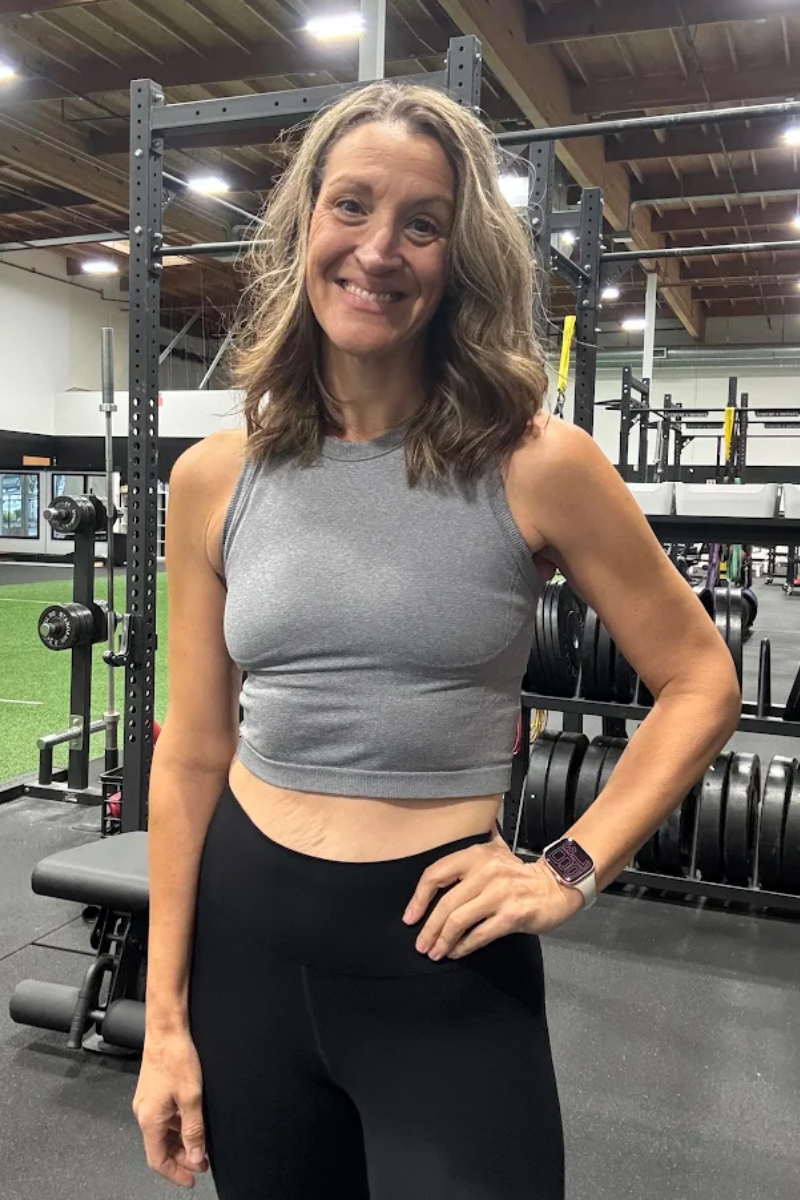
Coach Nicole Hinkle, personal and group strength coach at APEX PWR.
Coach Nicole Hinkle is a personal and group strength coach at APEX PWR, a 47-year-old mother of four, and someone navigating perimenopause herself. She also reclaimed her own fitness and nutrition after the busy family years pushed her health to the back burner. You can read her own comeback story here: Fueling the Family and Herself. She has lived the exact challenge our clients bring through the door.
Nicole is a Menopause Coaching Specialist certified through Girls Gone Strong. That means the woman writing your program understands both the training science and the hormonal context it sits inside, from the inside.
Here is how she puts it, building on the point that you do not need a special menopause program:
"While you don't need a specific menopause program, it definitely helps to have someone guiding you who is knowledgeable in all the things that come with perimenopause, and who is actually in that same phase of life and can understand where you are."
That is the whole idea. The program follows the same proven principles it always has. What changes is having a coach who understands the symptoms, the setbacks, and the wins because she is living them too, and who can adjust your training around a bad-sleep week or a joint-pain flare without losing the thread of progressive overload.
"Breaking the skinny stigma is half the work, and once it clicks, everything changes."
Coach Nicole Hinkle | Personal & Group Strength Coach, APEX PWR
Nicole works with women in both group and personal training, whichever fits your life and your starting point. Group training gives you structure, community, and coaching at a lower price point. Personal training gives you fully individualized programming and maximum attention. Both are built on the same foundation: sufficient challenge, progressive overload, and recovery, calibrated to you.
Expert Contributor
Coach Nicole Hinkle
Coach Nicole Hinkle is a personal and group strength coach at APEX PWR, a 47-year-old mother of four, and a Menopause Coaching Specialist certified through Girls Gone Strong. Navigating perimenopause herself, she works with busy mothers and professionals across the Portland metro who want to build strength, protect bone density, and feel capable through perimenopause, menopause, and beyond.
How to Start Perimenopause Strength Training in Tigard or Beaverton
If you are in the Portland metro and ready to build strength that carries you through this transition and past it, here is the path.
Start with a Strength Training Foundations Trial, in either group or personal training. It is a low-friction way to experience the coaching and programming and to meet a coach who understands training through the menopause transition.
Then get your objective baseline. Two Gold Standard measurements, both available in a single appointment at APEX PWR in Tigard:
DEXA Body Composition Scan: precise measurement of your lean mass and fat mass and how each is distributed, so you can see whether your training is building and preserving muscle.
DEXA Bone Density Scan: the same imaging used in clinical medicine to assess osteopenia and osteoporosis risk. Starting in your 30s and 40s, this catches negative trends early, which matters most through perimenopause.
Together, the baseline plus a well-designed program means you are not guessing. You know where your muscle and bone stand, and you can watch both respond to the work.
Build Strength That Carries You Through Menopause
Group or personal strength training in Tigard, serving Beaverton and the Portland metro, plus a DEXA body composition and bone density baseline. Coaching from someone who understands the transition.
Serving Tigard, Beaverton, Lake Oswego & the Portland Metro
APEX PWR is located at 11105 SW Greenburg Rd in Tigard, central to the Westside Portland metro. Clients from Beaverton reach us in roughly 10 to 15 minutes via OR-217. Clients from Lake Oswego, Tualatin, and West Linn are typically within a 10- to 15-minute drive. Our facility offers a quiet, intentional alternative to the standard commercial gym, with group sizes that protect coaching quality, which matters when your program needs to be built and progressed with care.
Frequently Asked Questions
Do I need a special menopause strength training program?
No. The principles of strength training do not change at menopause. Your muscles still respond to challenge. To build strength and muscle, training needs to provide an adequate stimulus: enough intensity (weight) and volume (sets and reps) to drive adaptation, applied with progressive overload and adequate recovery. A 2026 systematic review of 126 studies and over 4,000 women found that when resistance training provides sufficient stimulus, strength improvements are similar in premenopausal and postmenopausal women.
Can you build muscle during perimenopause and menopause?
Yes. Menopause does not prevent your muscles from adapting to strength training. Declining estrogen makes building and keeping muscle more challenging, and symptoms like hot flashes, insomnia, fatigue, and joint pain can make it harder to train consistently and recover. But the adaptation itself is still available. Well-designed resistance training with progressive overload builds strength and muscle through the menopause transition.
How does strength training help bone density during menopause?
Women lose bone density rapidly through perimenopause and the years following menopause as estrogen declines. Progressive resistance training loads the skeleton and stimulates bone. The LIFTMOR randomized controlled trial found that supervised high-intensity resistance and impact training, performed twice weekly, improved lumbar spine bone mineral density in postmenopausal women with low bone mass. A DEXA bone density scan establishes a baseline so you can track whether your training is protecting your bones.
How often should women strength train during perimenopause?
Two to four sessions per week covering the major muscle groups is sufficient for most women to build strength and support bone density. What matters most is sufficient challenge and progressive overload, gradually increasing weight, reps, or sets over time, along with enough recovery between sessions. Managing menopause symptoms helps you train consistently and recover well.
Where can I do perimenopause strength training near Tigard or Beaverton?
APEX PWR in Tigard, Oregon offers group and personal strength training for women navigating perimenopause and menopause, serving Beaverton, Lake Oswego, Tualatin, and the wider Portland metro. Coach Nicole Hinkle is a Menopause Coaching Specialist certified through Girls Gone Strong, and she is in perimenopause herself. The starting point is a Strength Training Foundations Trial, and a DEXA body composition and bone density scan provides an objective baseline.
Start Strong. Stay Strong.
Book a Strength Training Foundations Trial and get your DEXA baseline. Group or personal training in Tigard, serving Beaverton and the Portland metro.
Sources: Isenmann E, Geisler S, Havers T, et al. (2026). It's never too late: The impact of resistance training on strength and body composition in females across the lifespan, a systematic review and meta-analysis. Journal of Science and Medicine in Sport. Watson SL, Weeks BK, Weis LJ, Harding AT, Horan SA, Beck BR (2018). High-Intensity Resistance and Impact Training Improves Bone Mineral Density and Physical Function in Postmenopausal Women With Osteopenia and Osteoporosis: The LIFTMOR Randomized Controlled Trial. Journal of Bone and Mineral Research, 33(2), 211-220.
Fitness Is the First Thing Most Dads Drop. Two Ways Back. | APEX PWR Tigard & Beaverton APEX PWR | Dad Duty Fitness Is the First Thing Most Dads Drop By Jeron Mastrud, Co-Founder | Tigard, Oregon | October 14, 2026 APEX Co-Founder Jeron Mastrud working out at APEX Key Takeaways When work and fatherhood
RSMI: The Muscle Number on Your DEXA Report, and When It Should Send You to a Bone Scan | APEX PWR Tigard & Beaverton APEX PWR | Female Fitness RSMI: The Muscle Number on Your Report, and When It Should Send You to a Bone Scan By The APEX Team | Tigard & Beaverton, Oregon
Visceral Fat Climbs With Age. Get the Number Before It Does. | APEX PWR Portland & Tigard APEX PWR | Lessons in Longevity Visceral Fat Climbs With Age. Get the Number Before It Does. By The APEX Team | Tigard, Oregon | October 14, 2026 Key Takeaways Visceral fat sits around your organs. It is