Perimenopause Strength Training in Tigard, OR | APEX PWR
APEX PWR | Female Fitness & Performance
Perimenopause Strength Training in Tigard, OR
By the APEX PWR Team | Tigard, Oregon | Published May 2026 |
DEXA Scan
Our partner Thorne published a thorough primer on perimenopause this morning, walking through the hormonal shifts, the typical 2 to 8 year timeline, and the cluster of symptoms most women start to recognize in their 40s. If you haven't read it, it's a useful starting point: What Is Perimenopause? Symptoms, Age, Timeline, and What to Do Next.
Their article ends with the right question: what do you actually do about it? Their answer, fairly, includes lifestyle foundations and targeted supplements. We want to extend that answer. For most women navigating this transition, the highest-leverage piece of the equation is consistent, progressive strength training, supported by enough protein and clear data on what's actually happening in your body. Supplements have a role. Sleep and stress matter. But strength training is what moves the needle on the three things perimenopause is quietly working against: bone density, lean muscle, and metabolic health.
The single biggest lever for protecting bone density, preserving muscle, and managing the body composition shifts of perimenopause is consistent, progressive strength training.
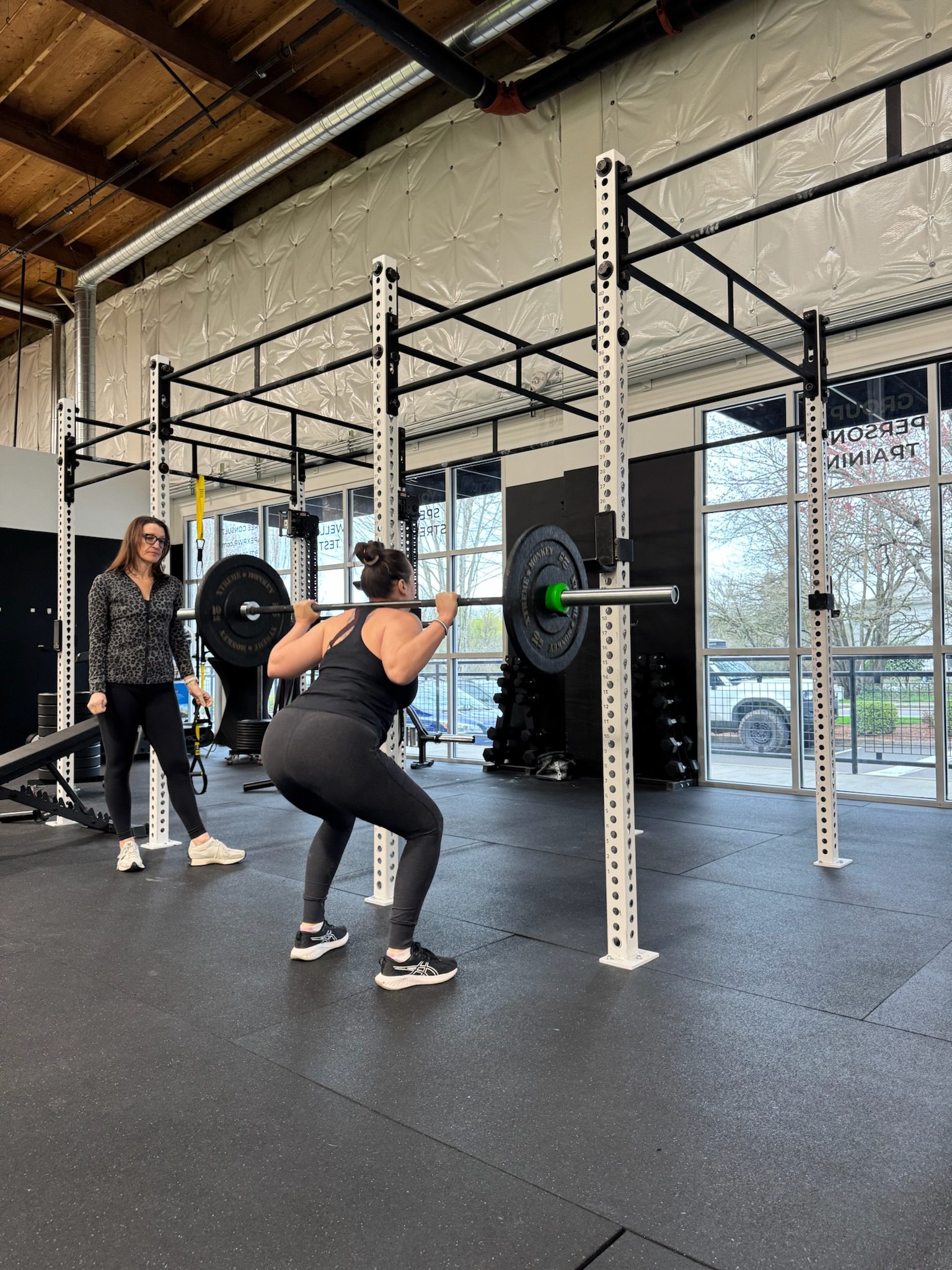
Coached strength training at APEX PWR in Tigard, OR.
What Perimenopause Is Actually Doing to Your Body
Estrogen does more than regulate your cycle. It's protective tissue across multiple systems: bone, muscle, vasculature, brain. As estrogen begins to fluctuate and trend down through perimenopause, three changes start happening that strength training directly counteracts.
1. Bone loss accelerates
Estrogen suppresses osteoclast activity, the cells responsible for breaking down bone tissue. As estrogen declines, bone resorption outpaces bone formation. Trabecular bone (the kind in your spine and hip) is the first to lose density. Most of this loss happens in the years immediately surrounding and following menopause, with much of the trajectory set during perimenopause.
2. Lean muscle declines faster
Sarcopenia, the age-related loss of muscle mass and function, progresses more rapidly during the perimenopausal transition. Without intervention, women lose roughly 3 to 8 percent of muscle mass per decade after age 30, and that rate tends to accelerate in perimenopause. Less muscle means lower resting metabolic rate, reduced glucose disposal, and decreased functional capacity over time.
3. Body composition shifts toward visceral fat
Lower estrogen is associated with redistribution of body fat toward the abdominal area. This isn't just a cosmetic concern. Visceral fat (the kind around your organs) is more strongly linked to cardiovascular and metabolic disease risk than subcutaneous fat. Research from the SWAN study and others confirms this redistribution is a hallmark of the menopausal transition.
These three shifts are compounding. Less muscle means less metabolic activity, which means more fat storage. More visceral fat drives insulin resistance, which makes maintaining muscle harder. Lower bone density quietly raises fracture risk for the next 30 years of your life. The good news: progressive strength training intervenes at every layer.
The Evidence: What Lifting Actually Does in This Population
The strongest evidence we have for lifting and bone density in this stage comes from the LIFTMOR trial (Watson et al., 2018, Journal of Bone and Mineral Research). 101 postmenopausal women with low bone mass were randomized into two groups: one performed 8 months of high-intensity resistance and impact training (deadlifts, back squats, overhead press at 80 to 85 percent of one-rep max, plus brief jumping and stomping). The other did a low-intensity home-based program.
The high-intensity group saw significant improvements in lumbar spine bone mineral density, femoral neck bone mineral density, height retention, and functional measures like the five-times sit-to-stand test. Critically, there were no fractures or injuries in the intervention group. The fear that lifting heavy is dangerous for women in this age range is not supported by the data when programming and supervision are appropriate.
A note on transparency: LIFTMOR studied postmenopausal women with diagnosed bone loss, not perimenopausal women specifically. The biological logic extends backward (the bone responds to mechanical loading at every age), but the perimenopause-specific RCT base is thinner. What we have is strong evidence that resistance training builds bone in the population with the most to lose, plus a solid biological case that intervening earlier in perimenopause is more leverage, not less.
The North American Menopause Society and the American College of Sports Medicine both recommend resistance training at least 2 days per week for women through and beyond perimenopause. Most current clinical guidance supports 2 to 4 sessions per week, with progressive overload as the active ingredient.
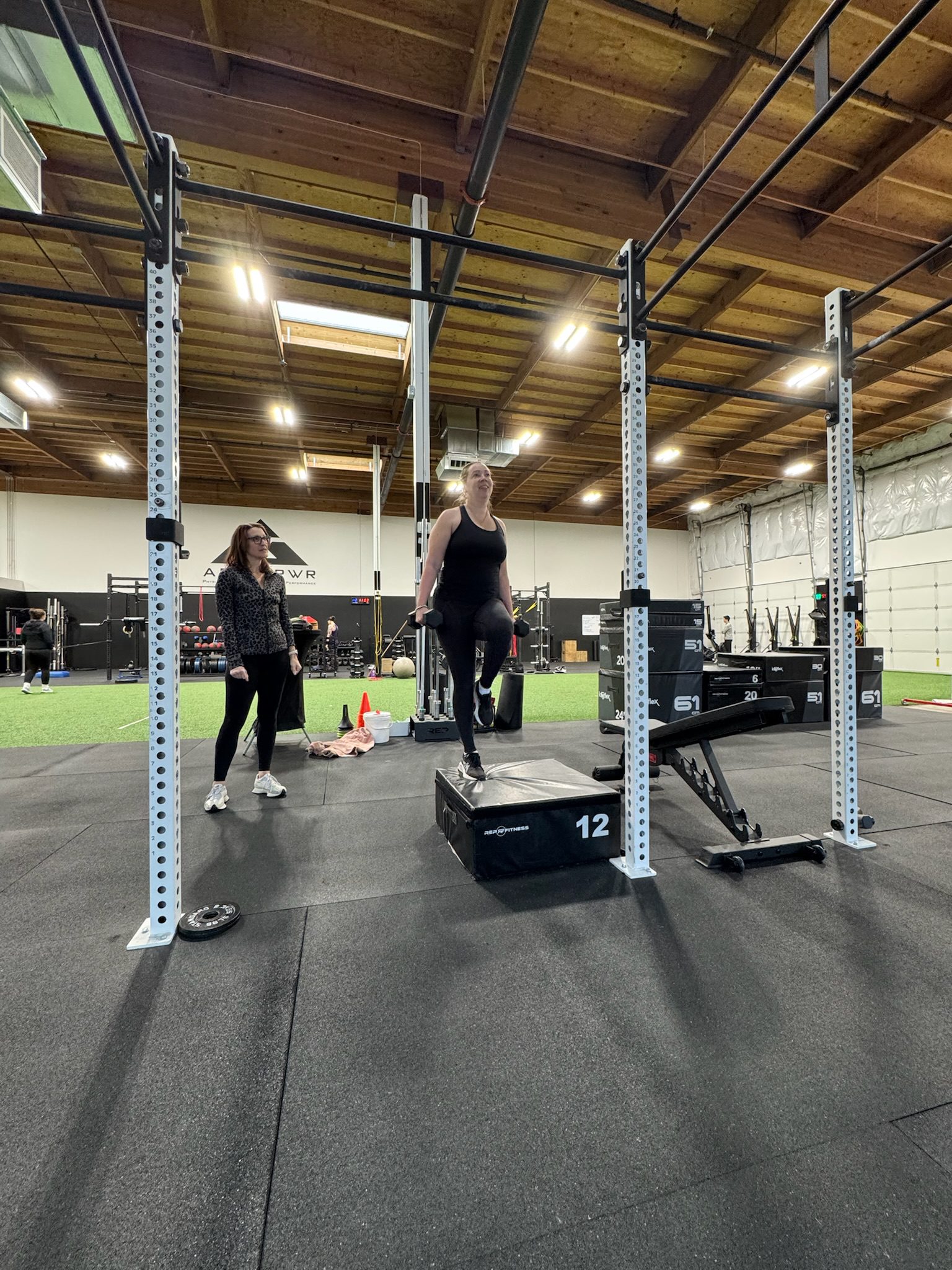
Strength training programming at APEX PWR includes both compound lifts and unilateral work.
Why DEXA Scans Matter Earlier Than Most Doctors Will Order One
The current USPSTF screening recommendation for bone density is age 65 for women without specific risk factors. For a woman in her early 40s entering perimenopause, that's potentially 20 to 25 years before anyone in the standard medical system will look at her bone density. By that point, you've lost what was most preventable.
A DEXA scan gives you three pieces of data that are otherwise invisible until something breaks:
Bone mineral density at the spine and hip, the two sites where fractures are most consequential
Lean muscle mass, distributed by region (left arm, right arm, trunk, left leg, right leg)
Visceral fat versus subcutaneous fat, separated out
A baseline scan in your 40s gives you a starting line. Repeat scans every 12 to 24 months show whether your training is actually protecting bone density, whether your protein intake and lifting are preserving lean tissue, and whether visceral fat is trending in the right direction. You act on the information while you have leverage, instead of finding out at 65 that the leverage is gone.
DEXA scanning is one of the most common entry points to APEX for women in this stage. We offer it on-site at our Tigard facility: Book a DEXA scan in Tigard, OR.
Nutrition: The Protein Floor Has to Go Up
Protein needs increase during perimenopause for two reasons. First, anabolic resistance (the body's reduced efficiency at using dietary protein to build and maintain muscle) increases with age. Second, the lean tissue loss that accelerates in perimenopause means the floor for protein intake has to be higher just to maintain what you have, before any thought of building.
Most current research supports:
0.8 to 1.0 grams of protein per pound of bodyweight per day
Distributed across 3 to 4 meals, with roughly 30 to 40 grams per meal
A meaningful protein dose at breakfast, which is the meal most women undereat protein
Pairing protein intake with resistance training within roughly 24 to 48 hours, not just a single post-workout window
This is the territory where our nutritionist, Jennie Carolan, works directly with clients in perimenopause. Generic meal plans rarely survive contact with real life. The goal of nutrition coaching at APEX is to be the last nutrition resource you ever hire, not a six-week fad you abandon when work travel hits.
How APEX PWR Supports Women in Perimenopause
APEX PWR is a performance wellness and rehab facility in Tigard, OR, serving the greater Portland metro area. We have certified perimenopause and menopause coaches on staff, and the full stack of tools that women in this stage actually need:
Strength training: personal and small-group, programmed by coaches who understand the population
DEXA scanning: on-site bone density, lean muscle, and body composition assessment with follow-up scans to track progress
Nutrition coaching: evidence-based, sustainable, built around your actual life
Physical therapy: in-house, for the joint and movement issues that often surface in this stage
Perimenopause and menopause coaching: dedicated support from coaches trained specifically in this transition
Where Supplements Fit (And Where They Don't)
Thorne carries a targeted formula called Perimenopause Complete, a multi-herbal blend with vitamin B6 designed to support sleep, mood balance, and reduction of common symptoms like hot flashes.* It pairs well with foundational nutrients that show up repeatedly in the perimenopause literature: vitamin D, omega-3 fatty acids, magnesium, calcium, vitamin K, and creatine. (Yes, creatine. Recent research, including Hall et al., 2025, supports creatine's role in body composition, strength, and cognitive performance for women in this stage.)
All of these are available through our Thorne dispensary at apexpwr.com/thorne.
The honest framing: supplements are supportive, not foundational. They can ease symptoms and fill nutrient gaps. They cannot substitute for resistance training, adequate protein, or sleep. We see this play out in our clients regularly. Supplements layered on top of a solid training and nutrition base produce real results. Supplements without the base produce expensive urine.
Start With Data, Then Build the Plan
If you're in Tigard or the greater Portland metro area and you're navigating perimenopause, the most useful first step is a DEXA scan and a conversation with our team. From there, we build the plan around strength training, nutrition, and the supportive pieces that fit your specific situation.
*These statements have not been evaluated by the Food and Drug Administration. This product is not intended to diagnose, treat, cure, or prevent any disease.
Sources: Watson SL, Weeks BK, Weis LJ, Harding AT, Horan SA, Beck BR. "High-Intensity Resistance and Impact Training Improves Bone Mineral Density and Physical Function in Postmenopausal Women With Osteopenia and Osteoporosis: The LIFTMOR Randomized Controlled Trial." J Bone Miner Res. 2018;33(2):211-220. doi:10.1002/jbmr.3284. Phillips SM, Chevalier S, Leidy HJ. "Protein 'requirements' beyond the RDA: implications for optimizing health." Appl Physiol Nutr Metab. 2016;41(5):565-572. Lovejoy JC, Champagne CM, de Jonge L, et al. "Increased visceral fat and decreased energy expenditure during the menopausal transition." Int J Obes (Lond). 2008;32(6):949-958. Janssen I, Heymsfield SB, Wang ZM, Ross R. "Skeletal muscle mass and distribution in 468 men and women aged 18-88 yr." J Appl Physiol. 2000;89(1):81-88. North American Menopause Society. 2021 Position Statement on Management of Osteoporosis in Postmenopausal Women. Hall L, Klassen S, Holbein J, Waters J. "Impact of creatine supplementation on menopausal women's body composition, cognition, estrogen, strength, and sleep." J Int Soc Sports Nutr. 2025;22(Suppl 1):2533673.
Your Scale Is a Bad Instrument for Perimenopause. Here Is What to Measure Instead. | APEX PWR Tigard & Beaverton APEX PWR | Female Fitness Your Scale Is a Bad Instrument for Perimenopause By The APEX Team | Tigard & Beaverton, Oregon | September 23, 2026 Key Takeaways Research following women across the menopause transition
MCL vs ACL: Why the First Read on a Knee Injury Is So Often Wrong | APEX PWR Physical Therapy, Tigard Oregon APEX PWR | Physical Therapy Feature MCL or ACL? Why the First Read on a Knee Is So Often Wrong. By Jeron Mastrud | Former NFL Tight End | Founder, APEX PWR |
He Eats the Same Lunch Every Day. Here Are the Macros, and the Skill Nobody Teaches You. | APEX PWR APEX PWR | Nutrition Nook He Eats the Same Lunch Every Day. Here Are the Macros, and the Skill Nobody Teaches You. By The APEX Team | Featuring Kevin Le, PT, DPT | Nutrition Coaching