Bone Density Scan vs Body Composition DEXA: What Each One Actually Tells You | APEX PWR Tigard, Oregon
APEX PWR | Lessons in Longevity
Bone Is Living Tissue. It Keeps What You Make It Earn.
By The APEX Team | Reviewed by Dr. Jordan Senn, Wellness Team | Tigard, Oregon | September 23, 2026
Key Takeaways
Bone is not a fixed structure you inherit and then spend down. It is living tissue that remodels continuously in response to the loads you put through it.
A new analysis in the BMJ pooled 124 randomized trials and 18,429 adults over 40. Structured exercise slowed and partly offset age-related bone loss at the spine, femoral neck and total hip.
The honest headline: brisk walking and jogging ranked highest overall, not lifting. Benefits started around 600 MET-minutes a week, roughly two to three hours.
That is not the whole case, though. Bone is site-specific. What loads the spine does not load the hip, and two-footed jumping actually reduces hip loading compared with walking.
Your body composition DEXA is not a bone density test. Research in 699 adults found the whole-body number under-called osteoporosis at the femoral neck.
A dedicated bone density scan measures your lumbar spine and both hips directly, and at APEX those results are reviewed by our physician at no extra appointment or fee.
Most people picture the skeleton as scaffolding. Inert, finished, holding everything else up, quietly wearing out on a schedule nobody controls.
That picture is wrong in a way that matters. Bone is one of the most metabolically busy tissues in your body. It is being demolished and rebuilt constantly by two cell populations working against each other, and the referee in that fight is mechanical load. Stress the tissue and the rebuilding side gets a reason to keep up. Remove the stress and your body draws the obvious conclusion, which is that it is maintaining something you are not using.
We have treated bone loss culturally as a tax on getting older. Something that happens to you, that you find out about after a wrist fracture in a parking lot. It is a lot more responsive than that.
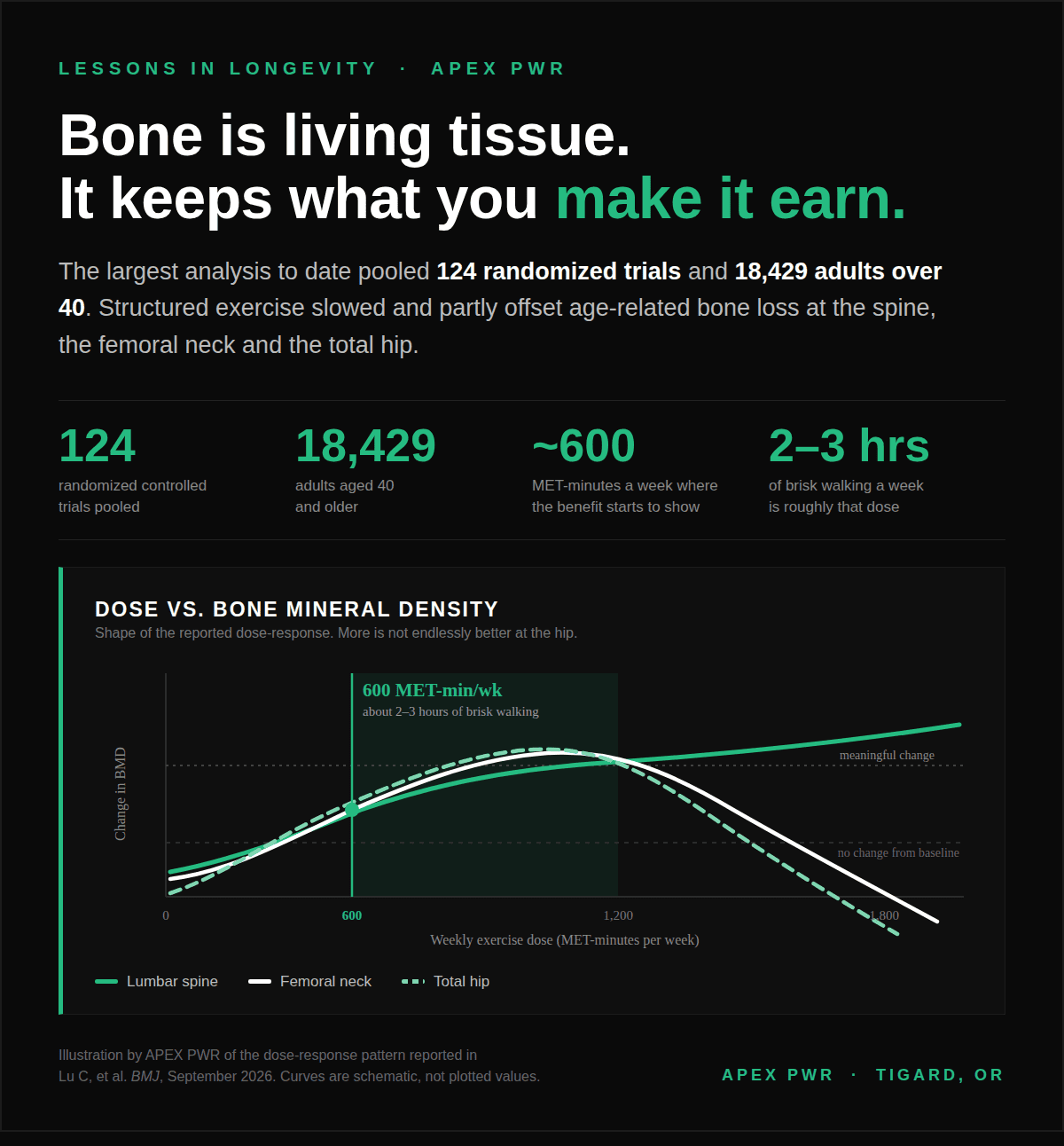
APEX illustration of the dose-response pattern reported by Lu and colleagues in the BMJ, September 2026. Curves are schematic and show the shape of the relationship, not plotted values.
What the New Research Actually Found
On September 21, 2026, the BMJ published the largest analysis of this question to date. Researchers pooled 124 randomized controlled trials covering 18,429 adults aged 40 and older and asked a straightforward question: does structured exercise change bone mineral density, and if so, how much of it do you need?
The answer was yes, with real qualifiers. Structured exercise produced what the authors described as a modest but clinically meaningful mitigation of age-related decline in bone mineral density at the lumbar spine, the femoral neck and the total hip. In plain terms, exercise did not turn a 55-year-old skeleton into a 30-year-old one. It meaningfully slowed the slide, and in places nudged it back.
Two findings deserve to be stated plainly, including the one that is inconvenient for a gym to report.
1. The dose is lower than you would guess
Benefits started showing up at around 600 MET-minutes per week. A MET-minute is just a unit of exercise volume: intensity multiplied by time. Six hundred of them is roughly two to three hours of brisk walking spread across a week. That is the threshold where the effect became visible, not the ceiling.
That number should be encouraging to anyone who has been told they need to overhaul their life. The entry price for defending your skeleton is two to three hours a week, and it does not have to start in a squat rack.
2. Walking and jogging ranked first, not lifting
This is the part a fitness facility is tempted to bury, so we will put it in bold. In this analysis, brisk walking and jogging came out on top for bone mineral density. Combined aerobic and resistance training also performed well, but across fewer skeletal sites.
The paper also reported something else worth knowing: effects were more pronounced in middle-aged people and in people with a healthy BMI, and blunted in older adults and in people with overweight or obesity. That is a real limitation, and if you are in one of those groups it is a reason to start sooner and expect a slower curve, not a reason to skip it.
If we only wanted to sell you personal training, we would have left that last section out. We are leaving it in because the next section is the one that actually matters, and it only works if you believe us.
Why "Just Walk" Is an Incomplete Answer
Bone mineral density is one outcome. It is a good one, it is the one every trial measures, and it is not the thing you are actually trying to prevent.
What you are trying to prevent is a broken hip at 74, and that event has two inputs. How strong the bone is, and how hard the ground hits it. Bone density research only speaks to the first. Muscle mass, leg strength, balance and reaction time decide the second, and none of those show up on a BMD readout.
There is also a specificity problem that gets lost in headlines, and it is the single most useful thing in this article.
Bone only adapts where it gets loaded
A 2024 modeling study examined what different activities do to hip contact force compared with ordinary walking. The results were counterintuitive enough that they changed how we program.
Activity
Effect on hip contact force vs. walking
Two-footed hopping
Reduced it by about 53%
Squat jumps
Reduced it by about 36%
Countermovement jumps
Reduced it by about 34%
Single-leg hopping
Increased it by up to about 21%
Running
Increased it by up to about 83%
Read that first row again. The two-footed jumping protocol that circulates every January as a bone-building hack is, by this modeling, less hip loading than a walk. When you land on two legs, you split the force and absorb it symmetrically. When you land on one, the hip has to take the whole thing and stabilize against it sideways, which is the input bone responds to.
And the spine is a separate problem entirely. Multiple analyses agree that jumping of any kind does very little for lumbar spine bone density. The spine responds to heavy axial load, which means a bar on your back. The LIFTMOR trial is the cleanest demonstration: heavy resistance training at above 80 to 85 percent of a one-rep max, five sets of five, produced roughly a 2.9 percent gain in lumbar spine bone density against a 1.2 percent loss in the control group.
The APEX Position
Walk for the general effect. Run or hop on one leg for the hip. Load a barbell for the spine. They are three different jobs and one of them will not cover the other two.
This is also why we are updating our own older content. We have a post on this site recommending ten minutes a day of jumping for bone density that predates the bilateral-versus-unilateral finding. It is on our list to correct. We would rather be publicly wrong and fix it than quietly leave it up.
One Line We Are Not Going To Cross
Nothing in this literature measured fracture as an outcome, so nobody, including us, can tell you that a training program will stop you breaking a hip. What the evidence supports is that exercise changes bone mineral density and builds the muscle and balance that keep you off the floor. Those are the honest claims and they are enough.
Now the Part Almost Nobody Explains: Your Body Comp Scan Is Not a Bone Density Scan
We have been running DEXA scans since 2016, and this is the most common and most consequential misunderstanding we run into.
A whole-body body composition DEXA does produce a total body bone density number. People see it, see that it looks fine, and reasonably conclude they have had their bones checked.
They have not, and there is good evidence for why that matters.
A study of 699 adults compared whole-body regional bone density against dedicated site-specific scans. At the group level the agreement was strong, with the spine correlating at r² 0.92 and the hip at r² 0.72. But the authors found the two approaches disagreed about the status of individual people, and specifically that the whole-body method under-called osteoporosis at the femoral neck.
The femoral neck is the site that breaks. It is the fracture that costs people their independence.
Worth knowing too: site-to-site disagreement is normal even between dedicated scans. Published rates put minor discordance between spine and hip at 39 to 44 percent and major discordance at roughly 3 to 5 percent. Bones in the same body are not on the same schedule. That is exactly why the diagnostic standard scans multiple sites directly instead of averaging your whole skeleton into one number.
The two scans, side by side
Body Composition DEXA
Bone Density DEXA
What it measures
Lean mass, fat mass, body fat percentage, visceral fat, skeletal muscle index
Bone mineral density at the lumbar spine and both hips (dual femur), with T-score and Z-score
What it answers
Where is my body composition now, and is my training and nutrition changing it
Where does my bone sit against young-adult peak and against people my age, and am I in osteopenia or osteoporosis range
What it cannot do
Give you a diagnostic bone result. It under-calls the hip in individuals
Tell you anything about your muscle, fat or visceral fat
Physician Reviewed, Without a Separate Doctor's Appointment
This is the piece we think people undervalue until they have sat with a result they do not understand.
A T-score and a Z-score are two different comparisons and they answer two different questions. The T-score compares you against young-adult peak bone mass, and it is what the osteopenia and osteoporosis categories are defined on. The Z-score compares you against people your own age and sex. Near peak bone mass those two numbers sit close together. By 60 they can be roughly two standard deviations apart, which means the same scan can look alarming or unremarkable depending on which number somebody reads you.
Getting that wrong in either direction has a cost. A frightened 42-year-old who did not need to be frightened, or a real finding that nobody acted on.
So at APEX, bone density scans are interpreted by our licensed team and reviewed by Dr. Jordan Senn, the physician on our wellness team. That review is included. No second appointment, no second fee, no waiting on a referral to get a clinician's eyes on your own numbers.
The most useful thing about having a physician inside the building is not the dramatic finding. It is the ordinary one: telling somebody that the number that scared them is within the expected range for their age, and here is what we are going to do about the part that is actually worth attention.
The APEX Wellness Team
Tigard, Oregon
Get Both Scans in One Appointment
They run back to back on the same machine at our Tigard facility, about seven to ten minutes each. One visit gives you your body composition baseline and a real diagnostic look at your spine and hips. Serving Tigard, Beaverton, Lake Oswego, Tualatin and the greater Portland metro.
We are not going to tell you everyone needs one, because that is not true and it is the kind of claim that makes testing facilities untrustworthy.
The clearest reasons to book one:
You are in the menopause transition or postmenopausal, particularly with any additional risk factor.
You have had a fracture from a fall that should not have broken anything.
You have a condition or take a medication that affects bone, or you are coming off estrogen therapy.
Your total body bone density came back low on a body composition scan and you want the sites that matter measured directly.
You have a family history of osteoporosis or hip fracture.
You are an athlete, or formerly one, with a history of stress fractures or long stretches of low energy availability.
There is also an honest case for an elective baseline for healthy women in their late 30s and 40s with none of the above, and we will state the case and its limits together. No guideline recommends scanning at that age. A low result at 38 would not put you on medication, because osteoporosis drugs are not indicated or well studied in healthy premenopausal women. What it would change is how we train you, and it gives you a real starting line to measure the next twenty years against.
The strongest evidence for that is a study following 451 women through the menopause transition, which found that bone density before the transition, and the rate at which it declined, each independently predicted later osteoporosis, and together predicted it about 2.7-fold. A counterweight worth stating: other work in older adults found a repeat scan four years later added little to prediction. The picture is not settled.
On Radiation, Since Everybody Asks
A spine and hip DXA delivers under 10 microsieverts. That is roughly one day of the background radiation you receive from simply existing, and less than a chest X-ray. It is not the reason to hesitate.
What We Do With the Result
A scan is a measurement. On its own it changes nothing. Here is the actual sequence once we have your numbers.
Interpretation. Your spine and dual-femur results, T-score and Z-score, reviewed by our physician and explained to you in language you can repeat to your family.
Load where it counts. Unilateral impact work for the hip, built gradually over about eight weeks. Supervised heavy axial loading for the spine. Both, because they are different jobs.
The nutrition side. Protein, calcium, vitamin D and total energy intake. Under-eating is one of the fastest ways to lose bone and one of the most common things we find. That is our nutrition team's half of this.
Retest on the right clock. Bone at twelve months, because a realistic gain is one to three percent and anything sooner is inside the noise of the machine. Body composition every eight to twelve weeks, where the changes are large enough to read.
Refer out when it is warranted. If your result belongs with a prescribing physician, we will tell you that plainly.
Bone loss is not a fixed cost of aging. It is a response to a lack of demand, and the entry dose for changing that is about two to three hours a week. Walking counts, and the research says it counts more than we expected. It also is not the whole answer, because the hip and the spine need loads that walking does not provide.
And before you decide any of that is urgent, you should know where you actually stand, which is a different scan than the one most people have had.
Stop Guessing About Your Bones
Physician-reviewed bone density scanning of the lumbar spine and both hips, in Tigard, Oregon. $167, or $299 for two. Add a body composition scan to the same appointment.
Does a body composition DEXA scan tell me my bone density?
Not reliably, and not at the site that matters most. A whole-body DXA reports a total body bone density number, and across a group that number tracks dedicated scans closely. For an individual it is different. A study of 699 adults found whole-body regional bone density correlated well at the group level but disagreed about the status of individual people, and specifically under-called osteoporosis at the femoral neck. A dedicated bone density scan measures the lumbar spine and both hips directly and produces the T-score and Z-score the diagnostic categories are defined on.
How much exercise does it take to protect bone?
The September 2026 BMJ analysis of 124 randomized trials and 18,429 adults aged 40 and over found benefits appearing around 600 MET-minutes per week, about two to three hours of brisk walking. Brisk walking and jogging ranked highest overall, and combined aerobic plus resistance training also performed well across fewer sites. Effects were smaller in older adults and in people with overweight or obesity.
Is jumping good for bone density?
It depends on how you jump and which bone you mean. A 2024 modeling study found two-footed hopping reduced hip contact force by about 53 percent compared with walking, with squat jumps and countermovement jumps also reducing it. Only running and single-leg hopping increased hip loading. Jumping does very little for the spine in any form. The spine responds to heavy axial loading, which the LIFTMOR trial showed with heavy barbell work producing about a 2.9 percent lumbar spine gain.
Are bone density results reviewed by a physician?
Yes. Scans are interpreted by our licensed team and reviewed by Dr. Jordan Senn, the physician on our wellness team, with no additional appointment or fee. You do not need a separate doctor visit to have a clinician look at your results.
Can I get both scans at the same appointment?
Yes. They are two scans on the same machine and are commonly run back to back in one visit at our Tigard facility. Each is $167, or $299 for a two-pack. A spine and hip DXA delivers under 10 microsieverts, roughly one day of background radiation and less than a chest X-ray.
How often should I repeat each scan?
Different clocks. Body composition every eight to twelve weeks, because fat mass typically moves well beyond the smallest change the machine can reliably detect in that window. Bone annually, because a realistic gain is one to three percent at the hip over six to twelve months, which sits at or barely above what a scan can detect.
Where do you serve?
Our facility is at 11105 SW Greenburg Rd in Tigard, Oregon, just off Highway 217 at Greenburg Road. We regularly see clients from Tigard, Beaverton, Portland, Lake Oswego, Tualatin, King City and Sherwood.
This article is educational and is not medical advice, a diagnosis, or a substitute for care from your own physician. Bone density scanning at APEX PWR is a cash-pay service. Interpretation and physician review are provided as described, and if your results warrant prescription treatment we will tell you to see a prescribing physician. No exercise program can be promised to prevent a fracture, and no trial cited here measured fracture as an outcome. If you have a diagnosed bone condition, a history of fragility fracture, or take medication affecting bone, talk with your physician before beginning impact or heavy resistance training.
Sources. Lu C, et al. Effect of exercise on bone health in middle-aged and older adults: hierarchical network meta-analysis of randomised trials. BMJ, published 21 September 2026; 124 randomised controlled trials, 18,429 participants aged 40 and older; dose threshold reported at approximately 600 MET-minutes per week; brisk walking and jogging ranked highest overall; effects attenuated in older adults and in participants with overweight or obesity. Altai Z, et al. (2024), hip contact force during hopping, jumping and running relative to walking. Watson SL, et al., LIFTMOR randomised controlled trial, high-intensity resistance and impact training in postmenopausal women with low bone mass; approximately +2.9% lumbar spine BMD versus −1.2% in controls. Melton LJ 3rd, et al. (2005), n=699, comparison of total body regional BMD against site-specific DXA; group-level correlation spine r² 0.92 and hip r² 0.72, with disagreement on individual status and under-detection of osteoporosis at the femoral neck. Shieh A, et al. (2021), JCEM, SWAN cohort, n=451; pre-transition lumbar spine BMD hazard ratio 1.78 per SD decrement and rate of decline HR 1.56 per 1%/year, 2.7-fold combined. Berry SD, et al. (2013), Framingham; limited incremental value of a repeat BMD at four years in older adults. Spine and femur DXA effective dose under 10 µSv per the ISCD radiation safety position. Spine-hip T-score discordance rates from published DXA concordance literature. Scan pricing as listed on apexpwr.com on 23 September 2026.
Visceral Fat Climbs With Age. Get the Number Before It Does. | APEX PWR Portland & Tigard APEX PWR | Lessons in Longevity Visceral Fat Climbs With Age. Get the Number Before It Does. By The APEX Team | Tigard, Oregon | October 14, 2026 Key Takeaways Visceral fat sits around your organs. It is
Your Scale Is a Bad Instrument for Perimenopause. Here Is What to Measure Instead. | APEX PWR Tigard & Beaverton APEX PWR | Female Fitness Your Scale Is a Bad Instrument for Perimenopause By The APEX Team | Tigard & Beaverton, Oregon | September 23, 2026 Key Takeaways Research following women across the menopause transition
MCL vs ACL: Why the First Read on a Knee Injury Is So Often Wrong | APEX PWR Physical Therapy, Tigard Oregon APEX PWR | Physical Therapy Feature MCL or ACL? Why the First Read on a Knee Is So Often Wrong. By Jeron Mastrud | Former NFL Tight End | Founder, APEX PWR |