GLP-1 Support in Portland, Oregon: Strength Training, Protein & DEXA Scans | APEX PWR
APEX PWR | Lessons in Longevity
GLP-1s Are a Tool, Not a Finish Line
By The APEX Team | Tigard, Oregon | Serving Portland, Beaverton, Lake Oswego, Tualatin, West Linn & Hillsboro | June 2026
Key Takeaways
GLP-1 medications work by reducing appetite and food intake, which creates a calorie deficit. They do not raise the calories you burn. The deficit is what drives the weight loss.
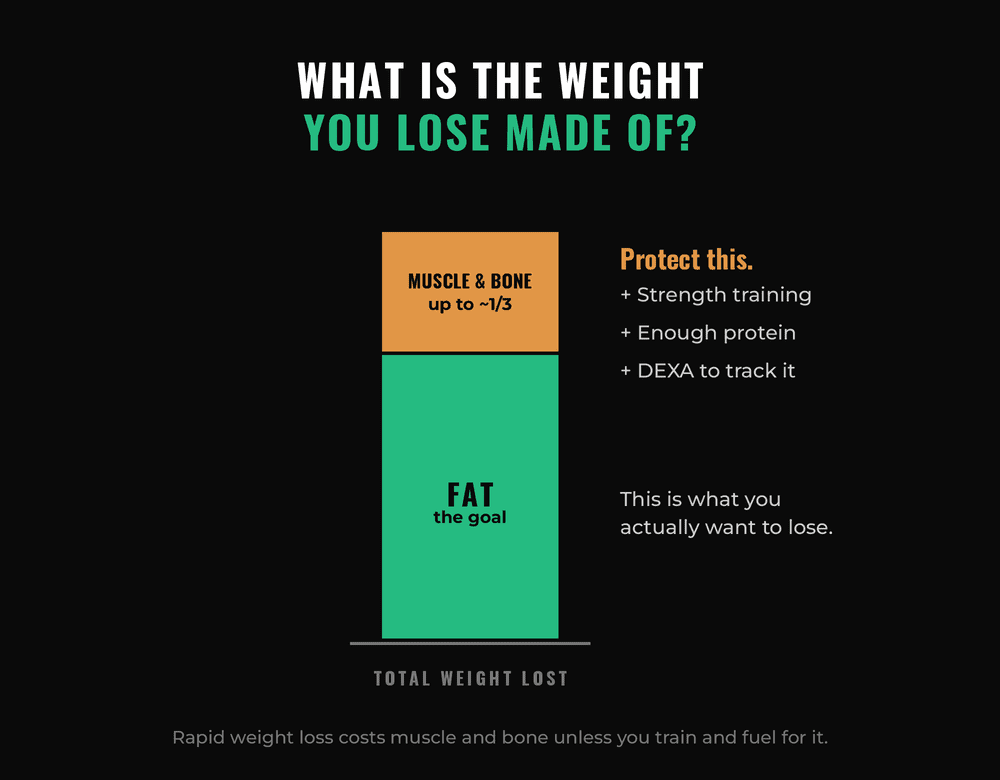
Rapid weight loss costs muscle and bone. On a GLP-1, lean mass commonly makes up roughly a quarter to over a third of total weight lost, and bone mineral density can decline at the hip and spine. Both are largely protectable.
Strength training plus adequate protein is the most evidence-supported way to defend lean muscle and bone while losing weight.
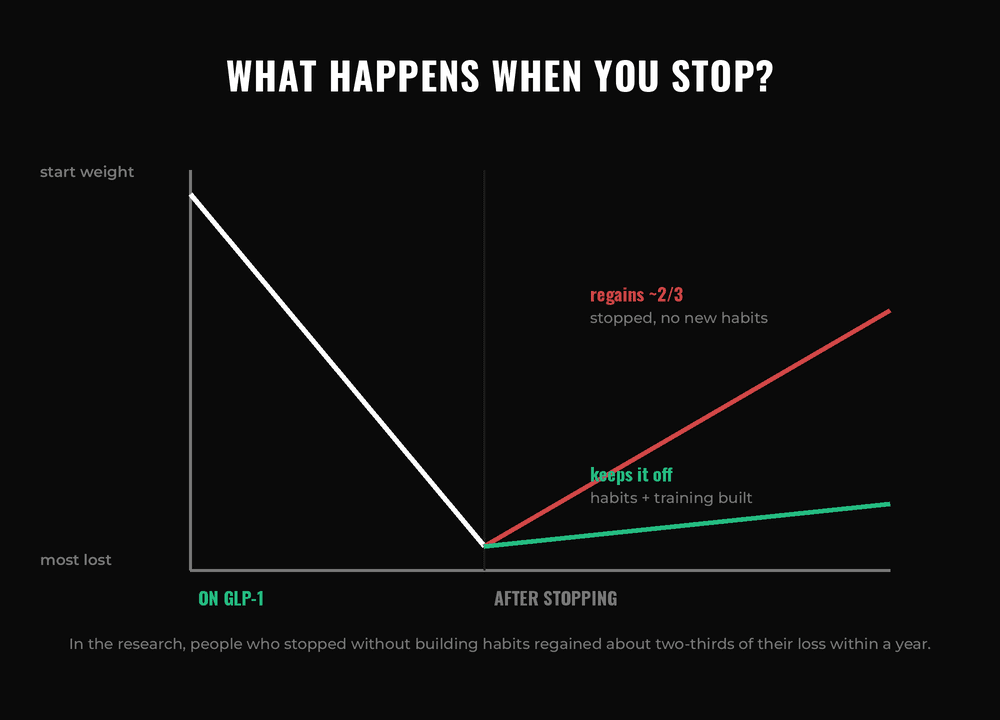
In the research, people who stopped a GLP-1 without building new habits regained about two-thirds of their lost weight within a year. The medication opens a window. Habits keep it open.
A DEXA body composition scan and a DEXA bone density scan give you an objective baseline to track what you are actually losing while on the medication.
APEX PWR does not prescribe GLP-1s. We are the lifestyle support: training, nutrition coaching, and body composition testing that turn a temporary result into a permanent one.
GLP-1 medications like semaglutide and tirzepatide, the active ingredients in Ozempic, Wegovy, Mounjaro, and Zepbound, are among the most effective tools for weight loss that medicine has ever produced. We are not here to argue with that. We see the results in the people who walk through our doors every week.
What we want to talk about is the part of the conversation that gets lost in the noise: what these medications actually do, what they quietly cost if you are not paying attention, and how to make sure the change you are paying for actually lasts. Because the people who get the most out of a GLP-1 are the ones who treat it as a starting line, not a finish line.
A quick, important note before we go further. APEX PWR does not prescribe or provide GLP-1 medications. That is a conversation for you and your medical provider. What we do is support the people on them, many of whom are referred to us by their own providers, with the training, nutrition, and measurement that the medication alone does not provide.
How Do GLP-1 Medications Actually Work for Weight Loss?
This is where a lot of confusion starts, so it is worth being precise. GLP-1 receptor agonists mimic a hormone your gut naturally releases when you eat. They slow digestion, blunt appetite, and quiet what many people describe as "food noise," the constant background pull toward eating. The result is that you eat less, often significantly less, without the white-knuckle effort that usually comes with it.
That reduced intake puts you in a calorie deficit, and the deficit is what produces the weight loss.
GLP-1s create a deficit by lowering intake. The research is clear they do not raise the calories you burn.
Here is the part people miss. The research is clear that GLP-1s work by reducing energy intake, not by raising energy expenditure. They do not speed up your metabolism. They do not increase the calories you burn. They make it easier to eat less. That distinction matters enormously, because it means the entire result rests on intake, and intake is something you can learn to understand and manage. That is the foundation of keeping the weight off.
If you want to actually understand your intake instead of guessing, a One-Time Macro Breakdown with our nutrition team gives you real, personalized targets to work from, which is exactly the kind of knowledge that has to outlive the prescription.
What Is the Weight You Lose on a GLP-1 Actually Made Of?
When the scale drops, most people assume it is all fat. It is not. Any rapid weight loss is a mix of fat and lean tissue, and "lean tissue" includes the muscle and bone you very much want to keep.
A meaningful share of weight lost on a GLP-1 can come from muscle and bone unless you train and fuel to protect it.
The trial data varies depending on the medication, the dose, and the study, but lean mass commonly accounts for roughly a quarter to more than a third of total weight lost on a GLP-1, and some studies report figures on the higher end of that range. Separately, significant and rapid weight loss is known to reduce bone mineral density, especially at the hip and spine.
Two things make this manageable rather than alarming. First, the bone density change appears to be driven mostly by the weight loss itself and the reduced load on your skeleton, not by a toxic effect of the drug. Second, and more importantly, both muscle loss and bone loss are substantially modifiable. Resistance training and adequate protein are documented to meaningfully reduce the lean mass lost during weight loss, and weight-bearing exercise plus protein, calcium, and vitamin D support bone.
You cannot control the fact that rapid weight loss pulls from muscle and bone. You can control how much, by training hard and eating enough protein while you lose.
Should I Do Strength Training While on a GLP-1?
For most people, this is the single highest-value thing you can do alongside the medication. Strength training is the most evidence-supported way to protect the lean muscle that would otherwise be lost, and it defends bone density and metabolic rate at the same time. The goal shifts from simply "lose weight" to "lose fat while keeping the muscle and bone that keep you strong, capable, and durable."
That muscle is not vanity. It is the tissue that keeps your metabolic rate up, keeps you functional as you age, and holds your results in place when the medication eventually stops. Losing weight while losing muscle leaves you smaller but weaker, with a lower metabolic floor that makes regain easier. That is the outcome we help people avoid.
We run three entry paths so the starting point matches the person, including those who have not trained in years or are carrying an injury.
Path 1
Personal 1-on-1 Training
Fully individualized coaching. Best if you want maximum attention and a program built entirely around you.
Path 2
Semi-Private Strength Classes
Premium small-group strength training led by a coach. The structure of programmed training with the energy of a group.
Path 3
1-on-1 Sports Physical Therapy
Strength-based physical therapy with our sports DPT team. Best if pain, an injury, or a movement limitation needs to be addressed before training at full intensity.
Most people start with the Strength Training Foundations Trial, a low-friction way to experience the coaching and find the path that fits before committing.
Protect Your Muscle While You Lose Fat
Start strength training with expert coaching, in a group or one-on-one. No experience required.
You cannot manage what you do not measure, and the bathroom scale measures the one thing that matters least. A falling number tells you that you are losing weight. It does not tell you whether you are losing fat or losing the muscle and bone you need to protect.
That is what body composition testing answers, and it is one of the most common reasons people on GLP-1s are referred to us.
DEXA Body Composition Scan: a precise breakdown of fat mass, lean mass, and how each is distributed across your body. On a GLP-1, this is how you confirm the weight you are losing is mostly fat and that your training and protein are protecting your muscle. It is the clearest answer to the question the scale cannot answer.
DEXA Bone Density Scan: the same gold standard imaging used in clinical medicine to assess osteopenia and osteoporosis risk. Because significant weight loss can pull down bone density at the hip and spine, a baseline and follow-up scan let you catch a negative trend early. This matters most for postmenopausal women and adults over 50.
Both scans can be done in a single appointment. A baseline before or early in your GLP-1 journey, with a follow-up later, turns guesswork into a clear picture of what is actually happening to your body, and gives your training and nutrition plan something concrete to respond to.
See What the Scale Cannot Show You
Body composition and bone density in one appointment. Know exactly what you are losing.
This is the question that decides whether a GLP-1 is a turning point or a temporary detour, and the research gives a sobering answer.
After stopping, the outcome splits on one variable: whether durable habits were built during the medication window.
In the STEP 1 trial extension, participants lost an average of about 17 percent of their body weight on semaglutide. Within a year of stopping the medication and the structured lifestyle support, they regained roughly two-thirds of what they had lost. The appetite suppression goes away when the medication does. If nothing durable was built in its place, intake climbs back up and the weight follows.
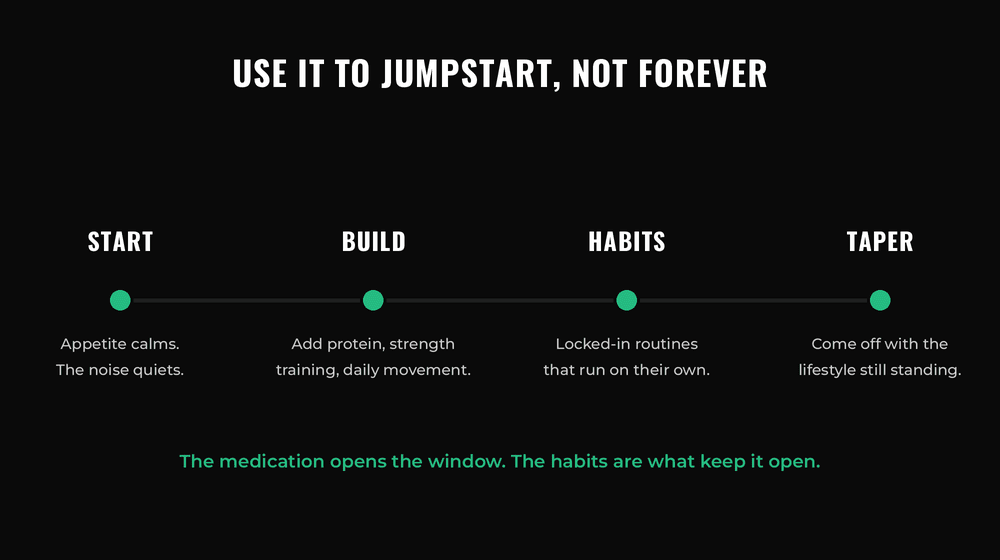
This is not an argument against GLP-1s. It is an argument against treating them as the whole plan. The medication buys you something incredibly valuable: a window where appetite and food noise are quiet enough that you can finally build the habits that were impossible to build before. The people who keep the weight off are the ones who use that window to establish real nutrition skills and a real training routine, so that when the medication stops, the lifestyle is already standing on its own.
The medication opens the window. The habits you build are what keep it open after you stop.
How Do You Build Habits That Outlast the Medication?
This is the heart of it, and it is exactly the work our nutrition team does. The window a GLP-1 creates is the best opportunity most people will ever get to rebuild their relationship with food, because the usual obstacle, relentless hunger, is temporarily out of the way. The mistake is to coast through that window and change nothing underneath.
Two things have to get built during that time. First, you need to understand your intake: how much you are actually eating, how much you need, and how to structure protein, carbs, and fats so that you protect muscle and feel fed. Second, you need a training habit that is genuinely part of your week, not a temporary push.
Our nutrition coaching is led by Jennie Carolan, MS, who holds a Master of Science in Food Science and Nutrition. Her framework is built for exactly this situation: eat as much as possible while still progressing, so that you protect lean muscle and metabolic rate and build food skills you can actually keep. That is the opposite of the crash-and-regain cycle, and it is what makes the difference once the medication is gone.
For most people on a GLP-1, the path looks like one of these:
One-Time Macro Breakdown: a single coaching session that turns your body and goals into specific daily targets for protein, carbs, and fats. Especially valuable on a GLP-1, where appetite is suppressed and it is easy to undereat protein without realizing it.
12-Week Nutrition Challenge: a structured, coached program with regular check-ins and accountability, built to install the habits over a full season so they are still standing when the medication stops.
Expert Contributor
Jennie Carolan, MS
Jennie Carolan holds a Master of Science in Food Science and Nutrition and leads the nutrition coaching practice at APEX PWR. Her coaching framework centers on eating as much as possible while progressing toward fat loss and body composition goals, protecting metabolic rate, lean muscle, and bone density along the way. She works with clients across the Portland metro area on sustainable, evidence-based change.
How APEX PWR Supports People on GLP-1s in Portland & Tigard, OR
We want to be the place people on GLP-1s come to for the part the medication cannot do. Not to sell you a drug, and not to talk you out of one, but to make sure that whatever weight you lose is the right kind of weight, and that it stays gone.
That support has three pillars, and they work together:
Just starting a GLP-1, deep into your weight loss, or planning how to come off it without losing your progress: this is the work that makes the change permanent at every stage.
A note on medical care. APEX PWR does not prescribe, provide, or manage GLP-1 medications. This article is educational and is not medical advice. Decisions about starting, adjusting, or stopping any medication should be made with your prescribing healthcare provider, and you should confirm with them before beginning a new exercise or nutrition program.
Make the Change Last
A GLP-1 can open the door. We help you build the strength, the habits, and the data to walk through it and stay there.
Any rapid weight loss, including weight loss from a GLP-1 medication such as semaglutide or tirzepatide, includes some loss of lean mass alongside fat. Trial data varies, but lean mass commonly accounts for roughly 25 to 40 percent of total weight lost, and some trials report more. The reassuring part is that this is largely modifiable. Resistance training and adequate protein intake are documented to substantially reduce the lean mass you lose during weight loss. This is why people on GLP-1s are often referred to start strength training.
Can GLP-1 medications affect bone density?
Significant, rapid weight loss is known to reduce bone mineral density, particularly at the hip and spine, and this applies to weight loss achieved with GLP-1 medications. The effect appears to be driven mostly by the weight loss itself and reduced mechanical loading rather than a direct toxic effect of the drug. Weight-bearing and resistance exercise, adequate protein, calcium, and vitamin D help protect bone. A DEXA bone density scan is the gold standard for measuring bone mineral density and tracking it over time, which is why it is commonly recommended as a baseline and follow-up for people on GLP-1s, especially postmenopausal women and adults over 50.
Why do people regain weight after stopping a GLP-1?
In the STEP 1 trial extension, participants lost an average of about 17 percent of their body weight on semaglutide, then regained roughly two-thirds of that loss within a year of stopping the medication and the structured lifestyle support. The medication suppresses appetite while you take it. If no durable nutrition and exercise habits are built during that window, appetite returns and intake climbs back up when the medication stops. Building those habits while on the medication is what makes the change last.
Should I do strength training while on a GLP-1?
For most people, yes. Strength training is the most evidence-supported way to protect the lean muscle that is otherwise lost during rapid weight loss, and it supports bone density and metabolic rate at the same time. APEX PWR offers strength training for people on GLP-1s through personal training, semi-private group classes, and one-on-one physical therapy for those who need to work around an injury or limitation first. Always confirm with your prescribing provider before starting a new exercise program.
How do GLP-1 medications actually work for weight loss?
GLP-1 receptor agonists work primarily by reducing appetite and food noise, which lowers how much you eat and places you in a calorie deficit. The research is clear that they work by reducing energy intake, not by raising the calories you burn. This is an important point: the deficit, not a metabolic boost, is what drives the weight loss, which means understanding and managing your intake is central to keeping the results.
Does APEX PWR prescribe GLP-1 medications?
No. APEX PWR does not prescribe or provide GLP-1 medications. We work alongside your medical provider as your lifestyle support: strength training to protect lean muscle, nutrition coaching to help you understand your intake and build lasting habits, and DEXA body composition and bone density scanning to track what is happening to your body during weight loss. Many of our clients are referred to us by their prescribing providers for exactly this reason.
Sources: Wilding JPH, Batterham RL, Davies MJ, et al. (2022). Weight regain and cardiometabolic effects after withdrawal of semaglutide: the STEP 1 trial extension. Diabetes, Obesity and Metabolism, 24(8), 1553-1564. Neeland IJ, et al. (2024). Changes in lean body mass with glucagon-like peptide-1-based therapies and mitigation strategies. Diabetes, Obesity and Metabolism. Prado CM, Phillips SM, Gonzalez MC, Heymsfield SB (2024). Muscle Mass and Glucagon-Like Peptide-1 Receptor Agonists: Adaptive or Maladaptive Response to Weight Loss? Circulation. Kushner RF, Calanna S, Davies MJ, et al. (2023). Bone mineral density and body composition in people with obesity treated with semaglutide 2.4 mg: a randomized, controlled trial. Obesity (Silver Spring), 31(12), 3027-3038. This article is educational and is not medical advice.
Fitness Is the First Thing Most Dads Drop. Two Ways Back. | APEX PWR Tigard & Beaverton APEX PWR | Dad Duty Fitness Is the First Thing Most Dads Drop By Jeron Mastrud, Co-Founder | Tigard, Oregon | October 14, 2026 APEX Co-Founder Jeron Mastrud working out at APEX Key Takeaways When work and fatherhood
RSMI: The Muscle Number on Your DEXA Report, and When It Should Send You to a Bone Scan | APEX PWR Tigard & Beaverton APEX PWR | Female Fitness RSMI: The Muscle Number on Your Report, and When It Should Send You to a Bone Scan By The APEX Team | Tigard & Beaverton, Oregon
Visceral Fat Climbs With Age. Get the Number Before It Does. | APEX PWR Portland & Tigard APEX PWR | Lessons in Longevity Visceral Fat Climbs With Age. Get the Number Before It Does. By The APEX Team | Tigard, Oregon | October 14, 2026 Key Takeaways Visceral fat sits around your organs. It is