Longevity Portland Oregon | 40 Is Not Old, Your Lifestyle Needs a Check-In | APEX PWR
APEX PWR | Lessons in Longevity
40 Is Not Old. But Your Lifestyle Might Need a Hard Look.
By Jeron Mastrud, Co-Founder & Former NFL Tight End | Tigard, Oregon | Serving Portland, Beaverton, Lake Oswego, Tualatin, West Linn & Hillsboro | July 2026
Key Takeaways
Forty is not old. When people feel old at 40, it is usually a lifestyle signal, not an age verdict, and lifestyle is the part you can change.
Four foundations carry the most weight in your 40s: daily movement, managing stress, strength training, and nutrition. Strength training pulls double duty, supporting both daily movement and stress.
Nutrition is the foundation underneath everything. Heavy alcohol, processed food, and adding a little weight every six months are the quiet trends that compound.
You cannot manage what you do not measure. A DEXA body composition scan, a VO2 max test, and a One-Time Macro Breakdown turn guesses into real numbers and trends you can act on.
Measuring your food builds food freedom, not restriction. It is what lets you make confident choices at events, while traveling, and when going out, without derailing your progress.
There is a take making the rounds on social media right now that lands harder than it should: the unpopular opinion that 40 years old is actually young, and that if you feel old at 40, it is less of an age issue and more of a lifestyle issue. It is the kind of line that stings precisely because there is truth in it.
Forty is not old. In the arc of a modern life, it is closer to halftime than the final whistle. So when someone hits their early forties and feels creaky, tired, and a step slow, the honest question is not "what did age do to me?" It is "what has my lifestyle been doing to me, quietly, for the last decade?" That distinction matters, because lifestyle is the part you get to change.
I think about this a lot, because I am watching it play out in real time with the people I came up with.
From APEX Co-Founder Jeron Mastrud
"Many of my closest friends are those that I played football with in college at Kansas State. As we all are approaching 40, navigating our careers and growing families simultaneously, it's becoming more and more obvious who are the ones that are still making time for themselves with strength training and nutrition."
Jeron Mastrud | Co-Founder, Former NFL Tight End
Playing tight end for Kansas State. The teammates from those years are the same friends I am watching navigate 40 now.
None of us are professional athletes anymore. We all have careers pulling at us and kids who need us. The gap between the friends who feel good in their bodies and the friends who feel old comes down to neither luck nor genetics. It traces back to a handful of habits, kept or dropped, over years. That is the whole ballgame, and it is good news, because habits can be rebuilt at any age.
The Lifestyle Check-In: Four Foundations of Longevity in Your 40s
If 40 has you feeling older than you want to, here is where to look. None of these are exotic. The power is in doing them consistently, and in being honest about where you actually stand.
01
Daily Movement
The body is built to move, and the modern default is to sit. Daily movement does not mean a punishing workout every day. It means walking, taking the stairs, playing with your kids, and staying out of the chair for long unbroken stretches. It is the baseline that everything else sits on top of, and it is the easiest foundation to rebuild first.
02
Stress
Career and family in your late thirties and forties is a pressure cooker, and chronic stress does real physiological damage over time. Managing it counts as a longevity input, not a luxury or a self-care cliche. The good news is that several of the other foundations, movement and strength in particular, are among the most effective stress regulators available, which is why they keep showing up on this list.
03
Strength Training
Strength training is the foundation that pulls double duty. It counts as daily movement, it is one of the best tools for managing stress, and it directly defends the lean muscle and bone density that decline with age. If you only have the bandwidth to add one new thing, this is the one with the widest return.
I want to speak directly to the former athletes reading this. If you played in college or professionally, you trained to compete for roster spots and win championships. As you get older, things change, and it can be genuinely defeating to walk into a gym and feel like a fraction of the athlete you once were. I know, because that exact feeling kept me from working out at all for a while. The mental block was real.
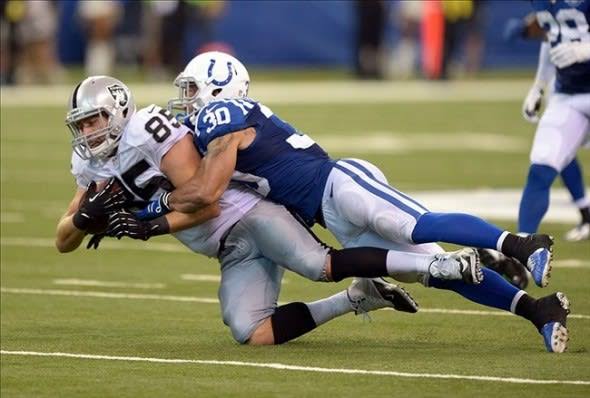
NFL days with the Raiders. The version of training that got me here is not the version that keeps me healthy now, and that is the point.
Then it clicked for me. The training program does not need to be that intense anymore. It just needs to be consistent. The goal shifted away from chasing the athlete I used to be and toward being healthy and strong for my wife, my kids, and myself. Independence and staying active in your 60s and 70s starts with what you are doing in your 30s and 40s. Building muscle now is what protects you later.
04
Nutrition: The Foundation
Underneath all of it is how you fuel your body. This is where the quiet trends live. Heavy alcohol. Processed food as the default. Adding a few pounds every six months without quite noticing. Individually small, these compound into the "I feel old" feeling by your mid-forties. The fix is not a crash diet, but an honest, measured look at what you are actually putting in, so you can adjust based on data instead of guessing.
Stop Guessing. Start Measuring.
Here is the part most people skip. You cannot manage what you do not measure, and almost everyone is guessing. They guess at their body composition by looking in the mirror. They guess at their fitness by how a flight of stairs feels. They guess at their nutrition by vibes. Guessing is how a decade slips by with the scale creeping up and the energy creeping down.
The alternative is to get real numbers, then watch the trends. Two metrics in particular are widely regarded as among the best windows into long-term health.
Metric 01
VO2 Max
Cardiorespiratory fitness, measured directly. It is one of the strongest predictors of all-cause mortality in the research, ahead of many of the risk factors people worry about more. The encouraging part: it is highly trainable at any age.
The Gold Standard for measuring fat mass, lean mass, and bone density. It tells you what the scale never can, whether you are holding muscle and protecting bone, or quietly losing both.
On the research behind VO2 max: a study of more than 122,000 adults found the least-fit group carried roughly five times the all-cause mortality risk of the elite-fit group, and a separate analysis of over 750,000 people found each meaningful step up in fitness was associated with a 13 to 15 percent drop in mortality risk, regardless of age. Cardiorespiratory fitness is one of the most powerful modifiable inputs to how long, and how well, you live. A VO2 max test in Portland, Oregon gives you that number to work from.
On the body side, a DEXA scan separates fat from lean mass and reads your bone density, the two things body weight alone will never tell you. For anyone in their 40s, that baseline is worth far more than the number on a bathroom scale.
Why Measuring Builds Food Freedom, Not Restriction
This is the part people get backwards. They assume that measuring food makes eating harder, a life of weighing chicken and logging every bite forever. The reality runs the other direction.
Get a One-Time Macro Breakdown, then measure and track your food for a stretch, even just to understand what you are putting in. At a minimum, after three to six months, you start to see trends. You can make small, easy adjustments that actually move the needle, grounded in real information instead of guesses. And here is the payoff: this builds food freedom, not a life of restriction.
Once you understand your numbers, you can make smart selections at events, while traveling, and when going out, the kind that keep you on track without derailing you or setting you back. That is freedom, not restriction.
It is the same lesson our nutrition team teaches every day. Knowing your foundation does not put you in a cage. It hands you the keys.
Where the Work Happens: Strength Training in Tigard and Beaverton
Knowing your numbers is the starting line. Building the strength, the lean tissue, and the durability that keep 40 feeling young is the work itself, and it is work you do not have to figure out alone. We would love to have you train with us. The easiest way in is the Strength Training Foundations Trial, and there are two paths depending on how you like to train.
Path 01
Group Strength Training
We handle the programming, ensuring a proper, progressive overload training program that actually builds measurable strength and lean tissue, the kind that shows up on your DEXA scan. All in a premium group setting inside our state-of-the-art, 10,000 square foot athletic training facility.
For those who want something one-on-one. Fully individualized coaching and programming built entirely around you, your goals, and your starting point, with a coach focused on you for the full session.
Whichever path fits, the Strength Training Foundations Trial is a low-friction way to experience the coaching and the programming before you commit. No experience required, and no need to already be in shape to start. That is what we are here for.
Expert Contributor
Jeron Mastrud
Jeron Mastrud is a co-founder of APEX PWR in Tigard, Oregon and a former NFL tight end who played collegiately at Kansas State. A Beaverton native, he leads content and community at APEX and writes on training, nutrition, and long-term health for busy parents and professionals navigating careers and growing families.
Build Your Longevity Baseline in Portland and Beaverton, Oregon
If you are in your 40s in the Portland metro and the "I feel old" feeling has crept in, the move is not to accept it. The move is to take an honest look and get your numbers. APEX PWR brings DEXA body composition, DEXA bone density, VO2 max testing, nutrition coaching, and strength training under one roof in Tigard, so the assessment and the plan live in the same place. For neighbors in Beaverton, we are a short drive south down OR-217, and Beaverton athletes and active adults make up a large part of who we train.
Get Your Longevity Numbers
VO2 max for cardiorespiratory fitness. DEXA for body composition and bone density. Real baselines to build healthy aging on, not guesses.
No. In the context of a full modern lifespan, 40 is closer to the midpoint of adult life than the end of it. When people feel old at 40, the cause is usually lifestyle, accumulated habits around movement, stress, strength, and nutrition, rather than age itself. Those habits are modifiable, which means how you feel at 40 is largely a problem you can work on.
What are the best metrics for longevity?
Two of the most useful objective metrics are VO2 max, a measure of cardiorespiratory fitness that is among the strongest predictors of all-cause mortality in the research, and body composition measured by DEXA, which separates fat mass from lean mass and assesses bone density. Together they give a clearer picture of long-term health than body weight alone.
What habits matter most for longevity in your 40s?
Four foundations carry the most weight: daily movement, managing stress, consistent strength training, and nutrition. Strength training is unique because it supports several of these at once, contributing to daily movement and to stress regulation. Nutrition is the foundation underneath all of it.
Does tracking my nutrition make eating harder?
Usually the opposite. Measuring your food for a few months gives you a true understanding of what you are eating, so you can spot trends and make small adjustments based on real data instead of guesses. Over time this builds food freedom, the ability to make confident choices at events, while traveling, and when going out, without derailing your progress.
Where can I get longevity testing in Portland, Oregon?
APEX PWR offers longevity-focused testing including DEXA body composition, DEXA bone density, and VO2 max at 11105 SW Greenburg Rd in Tigard, Oregon, serving the greater Portland metro including Beaverton, Lake Oswego, Tualatin, West Linn, and Hillsboro.
Do you offer strength training and longevity services for Beaverton residents?
Yes. APEX PWR is located in Tigard, a short drive south of Beaverton on OR-217, and Beaverton athletes and active adults make up a large part of who we train. Beaverton clients come to us for strength training, athlete development, DEXA and VO2 max testing, and nutrition coaching.
Sources: Mandsager K, et al. (2018), Association of Cardiorespiratory Fitness With Long-term Mortality, JAMA Network Open (122,007 adults). Kokkinos P, et al. (2022), Cardiorespiratory Fitness and Mortality Risk, Journal of the American College of Cardiology (US Veterans cohort). Opening quote attributed to Dan Go. Longevity figures reflect the published research base, not APEX outcomes. This article is educational and is not a substitute for individualized medical advice.
Fitness Is the First Thing Most Dads Drop. Two Ways Back. | APEX PWR Tigard & Beaverton APEX PWR | Dad Duty Fitness Is the First Thing Most Dads Drop By Jeron Mastrud, Co-Founder | Tigard, Oregon | October 14, 2026 APEX Co-Founder Jeron Mastrud working out at APEX Key Takeaways When work and fatherhood
RSMI: The Muscle Number on Your DEXA Report, and When It Should Send You to a Bone Scan | APEX PWR Tigard & Beaverton APEX PWR | Female Fitness RSMI: The Muscle Number on Your Report, and When It Should Send You to a Bone Scan By The APEX Team | Tigard & Beaverton, Oregon
Visceral Fat Climbs With Age. Get the Number Before It Does. | APEX PWR Portland & Tigard APEX PWR | Lessons in Longevity Visceral Fat Climbs With Age. Get the Number Before It Does. By The APEX Team | Tigard, Oregon | October 14, 2026 Key Takeaways Visceral fat sits around your organs. It is