Strength Training for Women and Bone Density: What Perimenopause Does to Your Skeleton | APEX PWR Tigard & Beaverton
APEX PWR | Female Fitness
Strength Training for Women and Bone Density: What Perimenopause Actually Does to Your Skeleton
By The APEX Team | Tigard & Beaverton, Oregon | October 21, 2026
Key Takeaways
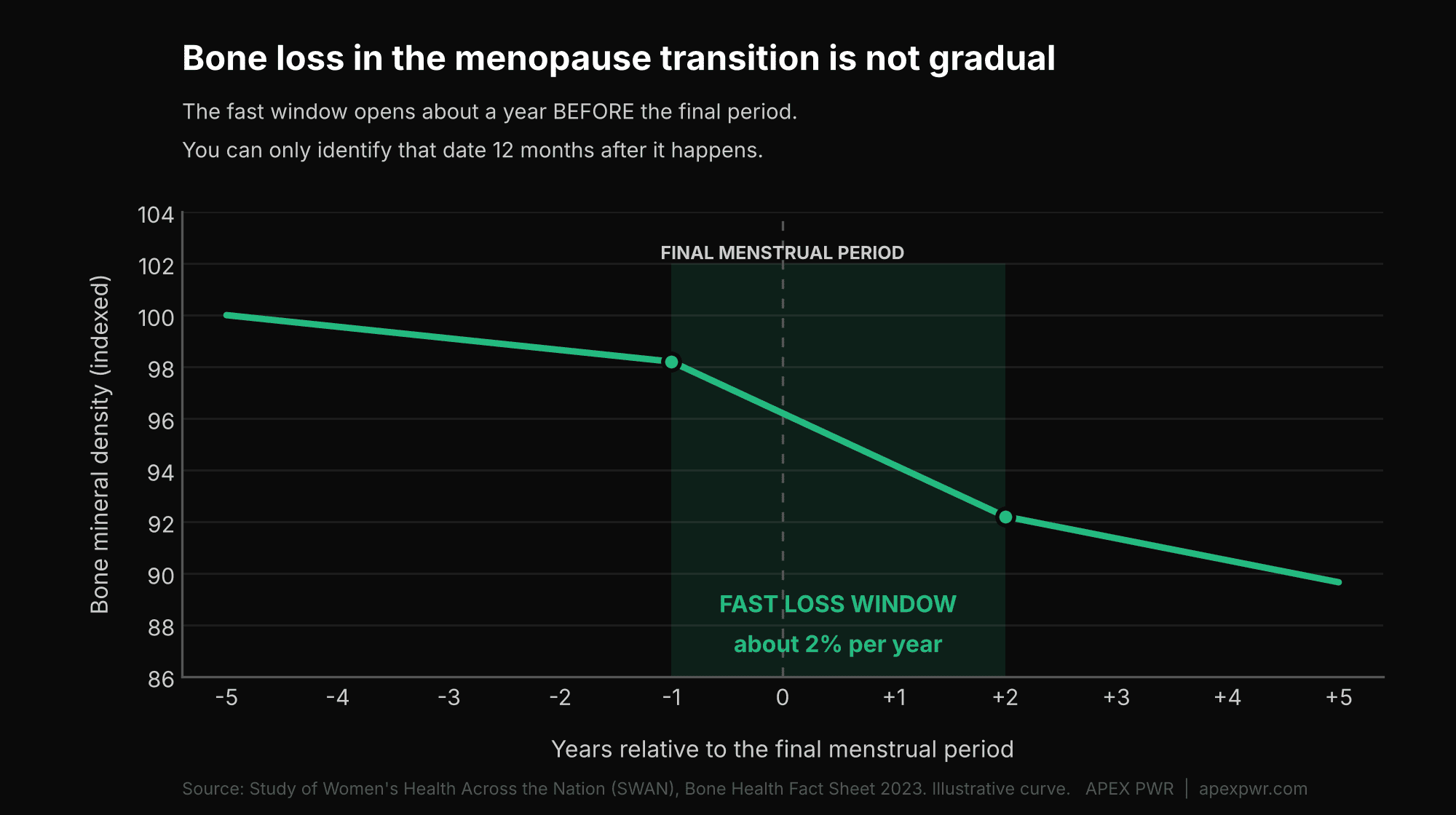
Bone loss through the menopause transition is not gradual. It concentrates into a fast window that opens about one year before the final menstrual period and runs roughly three years.
During that window the spine loses around 2 percent per year. Cumulative loss across the full ten-year transition averages about 10 percent.
The final menstrual period can only be confirmed twelve months after it happens, so the fast window is almost always already open before a woman knows she is in it.
Bone loss produces no symptoms. The first sign is often a fracture from a fall that should not have caused one.
Walking, hip loading and spine loading are three different jobs. Heavy axial loading is the one that reaches the lumbar spine.
A site-specific scan of the spine and both hips produces the T-score the diagnostic categories are defined on. At APEX PWR it is read by a physician at no additional charge.
Most of the bone health advice aimed at women has not moved in thirty years. Take calcium. Drink milk. Go for a walk. None of that is wrong exactly, and the walking part turns out to be better supported than fitness facilities like ours usually admit. What it misses is the part that actually determines outcomes, which is timing.
Bone loss through the menopause transition does not arrive as a slow, even slide you can start worrying about at sixty. It arrives in a burst. And the burst happens during a stretch of years when most women are told nothing is wrong, because nothing feels wrong.
Bone Loss Is Silent, and That Is the Whole Problem
There is no sensation attached to losing bone mineral density. No ache that builds, no stiffness that warns you, no symptom you could reasonably be expected to notice. A woman can move through the single fastest period of bone loss in her life while feeling entirely normal and getting entirely normal results at an annual physical.
The signals that do eventually show up are late ones:
Loss of height over a period of years
A forward curve developing in the upper back
Bone pain, as distinct from joint or muscle pain
A fracture from a fall that should not have been enough to break anything
By the time any of those appear, the loss that produced them happened years earlier. That is not a reason for alarm, and it is not a reason to assume the worst about your own skeleton. It is the reason measurement exists.
You cannot feel bone density. You can only measure it. Everything else is a guess about one of the few things in your health that is cheap and quick to actually know.
What the Menopause Transition Does, and When
The best longitudinal data on this comes from the Study of Women's Health Across the Nation, known as SWAN, which has followed a large multi-ethnic cohort of women through the menopause transition since the late 1990s. SWAN is useful here precisely because it measured the same women repeatedly rather than comparing different women at different ages.
1 year
before the final menstrual period is when rapid loss begins
SWAN, Bone Health Fact Sheet 2023
~2%
per year through the fast window, which runs about three years
SWAN, greater at spine than hip
~10%
cumulative decline across the ten years spanning the transition
SWAN longitudinal cohort
The fast loss window, indexed. The shaded region is where the slope changes.
Now put those three findings together with one more fact about how menopause is defined. The final menstrual period is identified retrospectively, confirmed only after twelve consecutive months without a period. Which means the window SWAN describes, opening a year before that event and running three years, is typically already open, and often most of the way through, by the time a woman can say with any confidence where she is in the process.
Why This Argues for a Baseline in Your Forties
A first bone density scan at sixty-five tells you where you ended up. A baseline at forty-five and a follow-up later tells you what happened and how fast, which is the information that actually changes what you do about it.
You will also see considerably larger numbers than 10 percent circulating online. Ten percent is what the cohort data supports, and it is quite enough to move a woman from comfortably normal into the low bone mass range if she started near the middle.
What the Numbers on a Bone Density Report Mean
Bone density results come back as a T-score, which compares your bone mineral density against a healthy young adult reference. The World Health Organization diagnostic categories are defined on this number:
T-score
Classification
Minus 1.0 and above
Normal
Between minus 1.0 and minus 2.5
Low bone mass (osteopenia)
Minus 2.5 and below
Meets the criterion for osteoporosis
Two things worth knowing about that table. The first is that these categories are defined on site-specific measurement of the lumbar spine and the hip. The total body bone number that prints on a body composition scan is a different measurement and is not what the categories were built on. We wrote a full piece on that distinction in bone density versus body composition scanning if you want the detail.
The second is that a T-score is a category boundary rather than a verdict on your life. Plenty of women sit in the low bone mass range and go on to live without ever breaking anything, because bone density is one input into fracture risk and the other inputs are muscle, balance and whether you fall in the first place.
Why "Just Walk" Is an Incomplete Answer
We published something last month that argued against our own commercial interest, and it is worth repeating here because it sets up the part that follows.
A September 2026 network meta-analysis in the BMJ pooled 124 randomized trials covering 18,429 adults aged 40 and over, and found that brisk walking and jogging ranked highest overall for bone mineral density outcomes. Not resistance training. Benefits began showing up around 600 MET-minutes per week, roughly two to three hours of brisk walking. We run a gym. We sell strength training. We published that anyway.
So walking counts, and it counts more than we expected. What it does not do is reach every part of the skeleton, and this is where specificity matters more than almost anything else in this article.
Bone adapts where it gets loaded, and nowhere else
Bone is living tissue that responds to mechanical stress by remodeling. The stress has to actually arrive at the site in question. A 2024 modeling study looked at what common activities do to hip contact force relative to ordinary walking, and the results reorganized how we program:
Activity
Effect on hip contact force vs. walking
Two-footed hopping
Reduced it by about 53%
Squat jumps
Reduced it by about 36%
Countermovement jumps
Reduced it by about 34%
Single-leg hopping
Increased it by up to about 21%
Running
Increased it by up to about 83%
The two-footed jumping protocol that circulates every January as a bone-building hack delivers less hip loading than a walk does, by this modeling. Land on two legs and you split the force and absorb it symmetrically. Land on one and the hip takes the whole thing and has to stabilize against it sideways, which is the input bone responds to.
The spine is a separate problem again. Jumping of any kind does very little for lumbar spine bone density. The spine responds to heavy axial load, meaning weight traveling down through it. The LIFTMOR trial is the cleanest demonstration we have: heavy resistance training above 80 to 85 percent of a one-rep maximum, five sets of five, produced roughly a 2.9 percent gain in lumbar spine bone density against a 1.2 percent loss in the control group. Worth noting the scope: LIFTMOR enrolled postmenopausal women with low bone mass, so the result speaks most directly to that group rather than to women earlier in the transition.
The APEX Position
Walk for the general effect. Run or load one leg at a time for the hip. Put weight on your back for the spine. Three jobs, three inputs, and none of them substitutes for the others.
What Actually Belongs in a Program
Translating the above into something a woman in her forties or fifties can act on:
Load that is genuinely heavy. Sets in the range of four to six repetitions with a weight that makes that range honest. Light weights for high repetitions build other qualities, and bone is not reliably one of them.
Axial loading for the spine. Weight travelling down through the trunk. Squat and deadlift patterns, loaded carries, trap bar work.
Unilateral and impact work for the hip. Single-leg loading, and running or hopping on one leg where joints and training history allow it.
Protein sufficient to support the muscle doing the loading. Our nutrition team works with clients on an individual target rather than a blanket number.
Vitamin D status worth knowing. Deficiency is common in the Pacific Northwest for obvious reasons. This is a conversation for your physician and a blood test rather than a guess at a dose. If you do supplement, our clients get a lifetime 25% off pharmaceutical-grade Thorne products.
Progression over time. Bone remodels slowly. A realistic gain at the hip is one to three percent across six to twelve months, which is why bone is rescanned annually rather than every eight weeks.
One thing you will notice is absent from that list. Hormone therapy comes up constantly in this conversation, and there is a real evidence base behind it for bone. It is also a prescription decision that belongs with your physician, and we are a training and testing facility rather than a prescribing one. We will tell you plainly when something sits outside our lane, and that sits outside our lane.
If you are starting from a long way back, that is a normal place to start from. Coach Nicole does most of our work with women navigating this stage, and her approach to perimenopause strength training is written up separately.
Who Reads Your Results
Dr. Jordan Senn, DO
Physician, APEX PWR Wellness Team
Dr. Senn reads and interprets site-specific DEXA bone density scans of the lumbar spine and both hips for APEX PWR clients. There is no separate physician appointment and no additional fee for that review.
This matters more than it sounds like it should. The usual route to a bone density scan runs through a referral appointment with your physician, then the scan, then a second appointment to hear what it said. Two visits, two copays, and a wait at each end.
At APEX the physician review is part of the scan. You can skip the referral visit and the follow-up visit if you prefer.
We do want to be clear that this is offered as a complement to your own care rather than a replacement for it. We encourage a collaborative approach and are glad to be in touch with your provider, or to have you share your results with them, so the information sits in your record where you actually receive care. If you have a diagnosed bone condition or a history of fracture, your physician should be in that loop.
Where to Start
If you train with us already, this is simpler than you might think: DEXA scanning is included for clients in group strength training and personal training. The people training here are working against measured data rather than an estimate, and that is deliberate.
If you are not training with us, the scan stands on its own. Both scans run on the same machine at our Tigard facility and are commonly done back to back in a single visit, five days a week including Saturdays.
Find Out Where You Actually Stand
Site-specific bone density scanning of the lumbar spine and both hips, read by a physician at no extra charge. Or start with body composition and add bone to the same appointment. Tigard, Oregon, off Highway 217, minutes from Beaverton.
Tell us what prompted the question and our team will point you to the right one. We will also tell you if the answer is neither, or not yet.
Frequently Asked Questions
When does bone loss actually start in perimenopause?
SWAN reports that rapid loss begins roughly one year before the final menstrual period and runs fast for around three years, averaging about 2 percent per year, with greater declines at the spine than the hip. Loss continues afterward at a slower rate. The complication is that the final menstrual period is only identifiable twelve months after the fact, so the window is usually already open before a woman knows she is in it. That is the argument for a baseline in your forties rather than a first scan in your sixties.
How much bone do women lose through menopause?
SWAN reports roughly 10 percent cumulatively over the ten years spanning the transition, with larger losses at the spine than the hip. Higher numbers circulate online. Ten percent is what the longitudinal data supports, and individuals vary considerably around that average.
Is walking enough to protect bone density?
Walking does more than most gyms admit. The September 2026 BMJ analysis of 124 randomized trials and 18,429 adults over 40 found brisk walking and jogging ranked highest overall, with benefits from around 600 MET-minutes per week. What walking does not do is load the lumbar spine, which responds to heavy axial loading. Walking, hip loading and spine loading are three separate jobs.
What do T-score numbers mean?
The WHO categories are defined on the T-score, which compares you against a healthy young adult reference. Minus 1.0 and above is normal. Between minus 1.0 and minus 2.5 is low bone mass, often called osteopenia. Minus 2.5 and below meets the criterion for osteoporosis. These are defined on site-specific spine and hip measurement rather than the total body number from a body composition scan.
Does APEX PWR include DEXA scans with training?
Yes. Scanning is included for clients in group strength training and personal training, so you are training against measured data. Scans are also available on their own, five days a week including Saturdays.
Who reads bone density results at APEX PWR?
Dr. Jordan Senn, DO, the physician on our wellness team. No separate appointment, no additional fee, no referral visit and no second copay. We encourage a collaborative approach and are glad to share results with your own provider so they are on file where you receive care.
I have low muscle mass on my body composition report. Does that mean my bones are a problem too?
Not necessarily. It is a reasonable prompt to look, though. We covered the muscle number and what a low reading should trigger in our piece on RSMI.
This article is educational and is not medical advice, a diagnosis, or a substitute for care from your own physician. Bone density scanning at APEX PWR is a cash-pay service. Interpretation and physician review are provided as described, and if your results warrant prescription treatment we will tell you to see a prescribing physician. APEX PWR does not prescribe hormone therapy or any other medication. No exercise program can be promised to prevent a fracture, and no trial cited here measured fracture as an outcome. If you have a diagnosed bone condition, a history of fragility fracture, or take medication affecting bone, talk with your physician before beginning impact or heavy resistance training.
Sources. Study of Women's Health Across the Nation (SWAN), Bone Health Fact Sheet, 2023: rapid loss beginning approximately one year before the final menstrual period, continuing fast for roughly three years at about 2 percent per year, with cumulative decline of around 10 percent over ten years and greater losses at the spine than the hip. Karlamangla AS, Burnett-Bowie SM, Crandall CJ. Bone Health during the Menopause Transition and Beyond. Obstetrics and Gynecology Clinics of North America, 2018. Bone Health and Osteoporosis Foundation: an estimated one in two women and up to one in four men over age 50 will break a bone due to osteoporosis. Lu C, et al. Effect of exercise on bone health in middle-aged and older adults: hierarchical network meta-analysis of randomised trials. BMJ, 21 September 2026; 124 randomised controlled trials, 18,429 participants aged 40 and older; dose threshold approximately 600 MET-minutes per week; brisk walking and jogging ranked highest overall. Watson SL, et al. High-Intensity Resistance and Impact Training Improves Bone Mineral Density and Physical Function in Postmenopausal Women With Osteopenia and Osteoporosis: The LIFTMOR Randomized Controlled Trial. Journal of Bone and Mineral Research, 2018; approximately 2.9 percent lumbar spine gain against a 1.2 percent control loss; participants were postmenopausal women with low bone mass. Altai Z, et al. (2024), hip contact force during hopping, jumping and running relative to walking. World Health Organization diagnostic criteria for osteoporosis based on T-score.
Strength Training for Women and Bone Density: What Perimenopause Does to Your Skeleton | APEX PWR Tigard & Beaverton APEX PWR | Female Fitness Strength Training for Women and Bone Density: What Perimenopause Actually Does to Your Skeleton By The APEX Team | Tigard & Beaverton, Oregon | October 21, 2026 Key Takeaways Bone loss
Grip Strength, Force Plates, and the Numbers That Track How You Are Aging | APEX PWR Tigard & Beaverton APEX PWR | Lessons in Longevity Grip Strength, Force Plates, and the Numbers That Actually Track How You Are Aging By The APEX Team | Tigard & Beaverton, Oregon | October 21, 2026 Key Takeaways In
6 Nutrition Label Hacks That Take 10 Seconds and No App | APEX PWR Tigard & Beaverton APEX PWR | Nutrition Nook 6 Label Hacks That Take 10 Seconds and No App By Jennie Carolan, MS, Nutrition Director | Tigard & Beaverton, Oregon | October 14, 2026 Slides from the original post by Jennie Carolan,