Why Working Out More Won't Help You Lose Weight | APEX PWR Portland Oregon
APEX PWR | Nutrition Nook
Why Working Out More Won't Help You Lose Weight
By The APEX Team | Tigard, Oregon | Serving Portland, Tigard, Beaverton, Lake Oswego, Tualatin, West Linn & Hillsboro | June 2026
Key Takeaways
Structured exercise is only around 5 percent of the calories most people burn in a day. Your basal metabolic rate (BMR) is 50 to 75 percent, and your daily non-exercise movement (NEAT) can be anywhere from 15 to 50 percent.
NEAT can swing by 1,000 to 2,000 calories per day between two people of the same size, which makes daily movement a far bigger lever for weight loss than a few workouts per week.
Eating less and less is not the answer. Chronic under-eating is documented to lower resting metabolic rate, strip lean muscle, reduce daily movement, and disrupt hormones, which makes fat loss harder over time.
BMR and RMR are close cousins, usually within about 10 percent of each other, and used interchangeably for nutrition planning. An RMR test measures yours directly in about 15 minutes.
The most reliable path is a sustainable nutrition structure that has you eating as much as possible while still progressing, paired with more daily movement and strength training to protect muscle and metabolic rate.
If you have ever added more gym sessions, run more miles, or pushed harder in class and watched the scale refuse to move, you are not doing it wrong. You are running into the math of how the human body actually burns energy.
This is one of the most common conversations our nutrition team has with new clients across the Portland metro. People arrive convinced that the answer to weight loss is simply more exercise. The honest answer is that exercise is one of the smallest pieces of your daily calorie burn, and treating it as the main lever is why so many people work hard and get stuck.
Here is what is actually happening, and what to do instead.
The total number of calories you burn in a day is called your Total Daily Energy Expenditure, or TDEE. It is the sum of four parts, and the surprise for most people is how small the exercise slice really is.
Calories in is what you eat. TDEE is everything your body burns: BMR, NEAT, TEF, and exercise.
Breaking down the four components:
BMR, basal metabolic rate (50 to 75 percent). The calories your body burns just to keep you alive: heart, lungs, brain, organs, body temperature. This is the biggest piece by far.
NEAT, non-exercise activity thermogenesis (15 to 50 percent). Everything you do that is not formal exercise: walking, standing, taking the stairs, carrying groceries, fidgeting, pacing on a call.
TEF, the thermic effect of food (10 to 15 percent). The energy your body spends digesting and processing what you eat.
Exercise (around 5 percent). Your actual workouts. For most people, the smallest slice of the pie.
Look at that last number again. For a typical person who trains a few times a week, structured exercise is roughly 5 percent of daily burn. You cannot out-train the other 95 percent, and that is exactly why "just work out more" stalls so often.
Exercise is the smallest slice of your daily calorie burn. If it is the only lever you are pulling, you are working hard on about 5 percent of the equation.
If Exercise Is So Small, What Actually Drives Weight Loss?
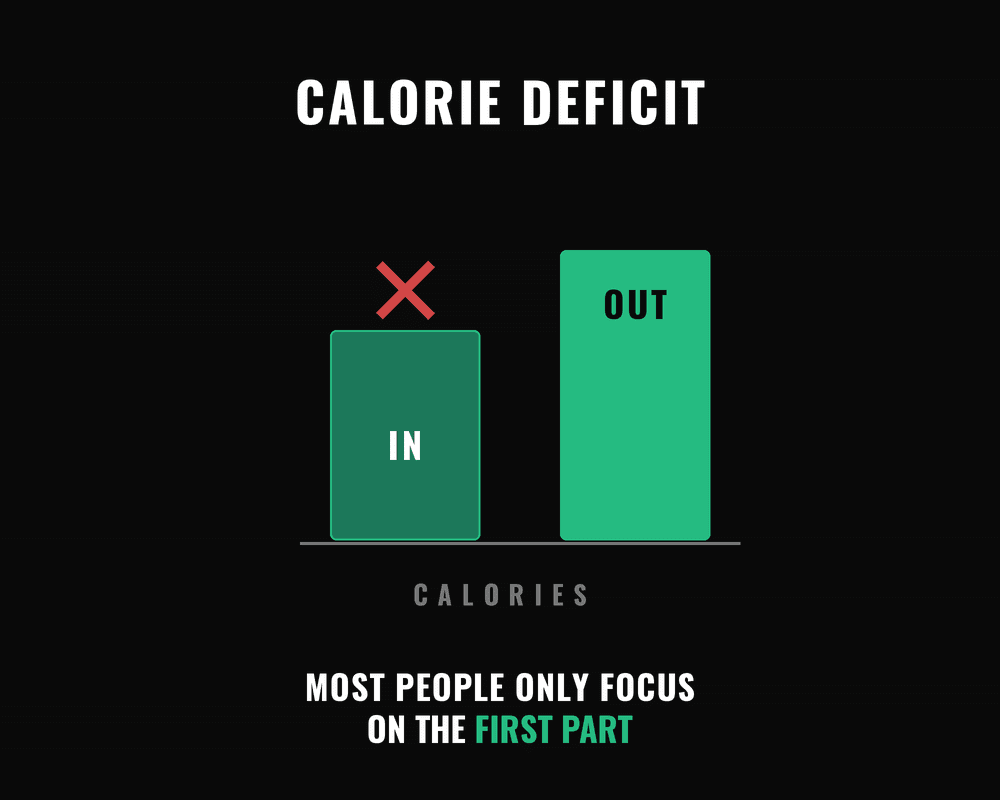
Weight change comes down to energy balance: the calories you take in versus the calories you burn out across the entire day. Most people fixate on the "out" side and assume that means workouts. It does not. The "out" side is dominated by your BMR and your NEAT, and the "in" side is the one you can influence most directly and immediately.
A calorie deficit has two sides. Most people obsess over burning more and ignore the side they control best.
This is the reframe our coaches use constantly. You do not need to punish yourself with more cardio. You need a nutrition structure you can actually keep, plus more movement woven through your ordinary day. That combination creates a sustainable deficit without the burnout that comes from trying to exercise your way out of everything.
The fastest way to put real structure behind the "in" side is to know your numbers and build a plan around them. That is exactly what our One-Time Macro Breakdown is for: a single session with a coach that turns your body and your goals into clear daily targets you can run on your own.
What Is NEAT, and Why Does It Matter More Than the Gym?
NEAT is all the movement in your day that is not a workout. It sounds minor. It is not. NEAT is the single most variable part of your daily burn, and the research on it is striking: it can differ by 1,000 to 2,000 calories per day between two people of the same size, depending entirely on how much they move outside the gym (Levine, 1999 and 2002).
NEAT is the most variable part of your daily burn, and the easiest one to grow without a single extra workout.
That number is larger than what almost anyone burns in their actual training sessions. A desk worker who sits most of the day can burn dramatically less than someone in the same body who walks, stands, and stays active between tasks. No gym membership required.
Practical ways to grow your NEAT:
Set a daily step goal and treat it like an appointment
Stand and move during calls instead of staying seated
Take the stairs, park further out, carry your own bags
Add a short walk after meals, which also helps blood sugar
Build small movement into transitions in your day rather than batching it all into one workout
This is freeing news for busy parents and professionals. The lever that matters most is not another hour you do not have. It is the movement you can layer into the hours you already spend.
Won't Eating Less Just Make Me Lose Weight Faster?
This is where many people, especially women, take a wrong turn. If exercise is not the answer and a deficit is what matters, the logical-seeming move is to slash calories hard. Eat 1,200. Eat 1,000. Eat 800 of "clean" food and call it discipline.
It backfires, and here is the mechanism behind why.
01
Your metabolic rate adapts downward
When you chronically eat well under what your body needs, it responds by burning less. This is called adaptive thermogenesis, and Rosenbaum and Leibel's work documents a measurable drop in resting metabolic rate beyond what weight loss alone would predict. The floor sinks under your feet, so you have to eat less and less just to maintain, which is the trap most chronic dieters describe.
02
You lose muscle, which lowers your BMR further
In an aggressive deficit without enough protein, the body breaks down lean muscle alongside fat. Because muscle is the primary driver of your resting metabolic rate, losing it pulls your BMR down even more. You end up smaller, weaker, and with a slower engine, which is the opposite of what makes fat loss sustainable.
03
Your NEAT quietly collapses
Under-fueled bodies conserve energy in ways you do not consciously notice. You fidget less, you take fewer steps, you sit more, you feel sluggish. That drop in NEAT can erase a large part of the deficit you were trying to create by eating less, which is why the scale so often stalls even on very low intake.
04
Hormones and long-term health take the hit
Chronic low energy availability is linked to disrupted reproductive and thyroid hormone function and to declining bone mineral density over time. You can be thin and still be losing the muscle and bone that keep you strong and durable for decades. Body weight alone is a poor measure of health.
The takeaway is not that deficits are bad. A reasonable, sustainable deficit is how fat loss happens. The point is that starving yourself is a slow-motion own goal. It damages the exact systems, muscle and metabolic rate, that make continued progress possible.
Eating less and less is not discipline. It lowers your metabolic rate, costs you muscle, and quietly shuts down your daily movement. The goal is to eat as much as possible while still progressing.
How Do You Lose Weight While Eating as Much as Possible?
This is the principle at the center of how Jennie Carolan coaches nutrition at APEX. The objective is not the steepest deficit your spreadsheet allows. It is the smallest effective deficit that still moves you forward, built on enough food to protect your muscle, your hormones, and your metabolic rate along the way.
In practice that means a few things working together: enough total calories to keep your engine running, enough protein to defend lean muscle (protein also carries the highest thermic effect of any macronutrient, so it costs more energy to digest), strength training to build and keep the muscle that raises your BMR, and daily movement to grow your NEAT. None of that requires misery. It requires structure.
For most people, the entry point is one of two things. The One-Time Macro Breakdown gives you your personalized numbers and the resources to execute on your own. The 12-Week Nutrition Challenge gives you a structured, coached program with check-ins and accountability when you want support actually building the habits, not just the spreadsheet.
Get a Plan You Can Actually Eat
Stop guessing and start with real numbers and real structure. Pick the level of support that fits you.
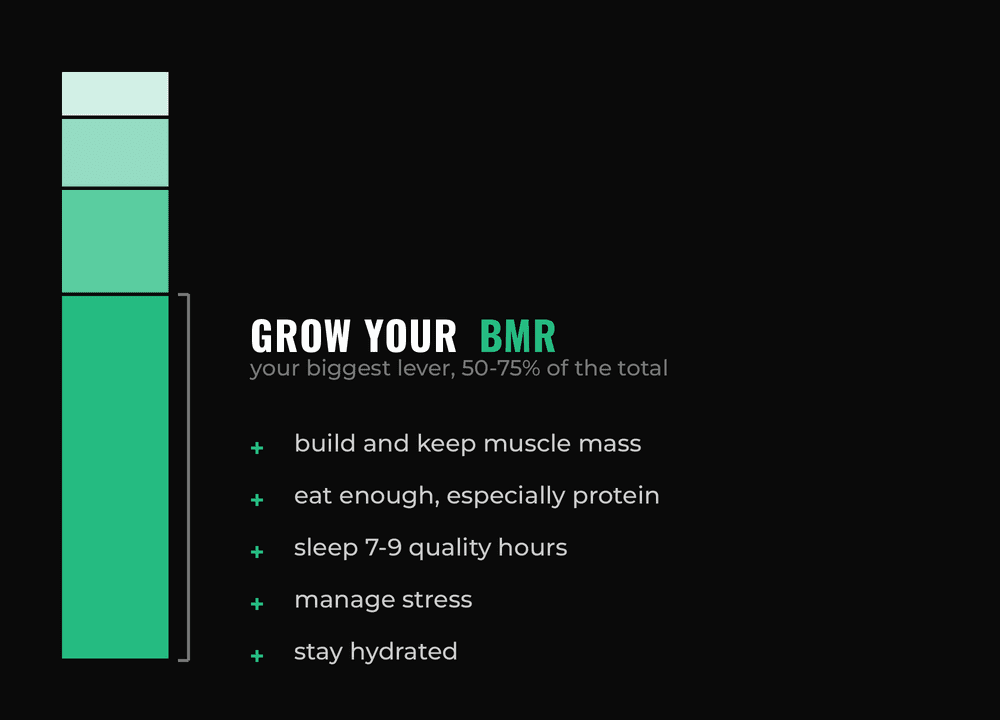
Your BMR is the biggest slice of your daily burn, so raising it has the largest long-term payoff. You cannot change it overnight, but you can absolutely grow it over months and years.
BMR is 50 to 75 percent of your daily burn and the lever with the biggest long-term payoff.
The drivers that move it:
Build and keep muscle mass. Muscle is metabolically active tissue. More of it raises the floor of your daily energy burn.
Eat enough, especially protein. Under-eating lowers your BMR. Adequate fuel and protein protect it.
Sleep 7 to 9 quality hours. Poor sleep disrupts the hormones that regulate hunger and metabolism.
Manage stress. Chronic stress works against recovery, sleep, and consistent eating.
Stay hydrated. A simple, foundational input that supports every system above.
Notice that none of these is "do more cardio." Growing your BMR is about building a stronger, better-fueled, well-rested body, which is the same body that handles everyday life with more energy.
What Is the Difference Between BMR and RMR?
These two terms get used interchangeably, and for practical purposes that is fine, but the distinction is worth understanding.
BMR (basal metabolic rate) is measured under strict laboratory conditions: overnight fast, full rest, controlled environment. RMR (resting metabolic rate) is measured under slightly less strict conditions and is what is performed in nearly every clinical and commercial setting. The two numbers typically land within about 10 percent of each other, which is why "BMR" and "RMR" are used interchangeably in everyday nutrition planning.
When someone offers an "RMR test," they mean the test that measures your real resting burn. That is the number worth knowing, because every nutrition decision you make should be calibrated against it.
How Do I Find Out My Real Metabolic Rate?
There are two ways to get a BMR or RMR number, and they are not equally accurate.
The first is an online calculator using a predictive equation like Mifflin-St Jeor or Harris-Benedict. These estimate your rate from your age, sex, height, and weight. They are a reasonable starting point, but Frankenfield and colleagues' 2005 systematic review found that even the most accurate equation produced individual errors of 200 to 500 calories or more in a meaningful share of people. A 300-calorie miss in either direction is the difference between steady progress and months of frustration.
The second is an RMR test using indirect calorimetry, which directly measures the calories your body burns at rest. You breathe normally through a mask for about 15 minutes while the device measures your oxygen consumption and carbon dioxide production, then calculates your exact resting metabolic rate. This is the Gold Standard outside of a research lab, and we offer it here in Portland.
If you want your real number rather than an estimate, the RMR test in Portland takes the guesswork out of where your floor actually sits. Pair that measured number with a coached plan and you are no longer guessing on either side of the equation.
Expert Contributor
Jennie Carolan, MS
Jennie Carolan holds a Master of Science in Food Science and Nutrition and leads the nutrition coaching practice at APEX PWR. Her coaching framework centers on eating as much as possible while progressing toward fat loss and body composition goals, protecting metabolic rate, lean muscle, and bone density along the way. She works with clients across the Portland metro area on sustainable, evidence-based change.
Where Do I Start?
If this article put words to why your hard work has not been paying off, the next step is simple. Stop pouring all your effort into the 5 percent and build a plan around the parts that actually move the needle.
Two paths, depending on how much support you want:
One-Time Macro Breakdown: a single coaching session that translates your goals into specific daily targets for protein, carbs, and fats, with the resources to run it yourself. The fastest way to put structure behind your nutrition.
12-Week Nutrition Challenge: a structured, coached program with regular check-ins and accountability, built for people who want to actually change their habits over a full season, not just get a number.
Work Smarter, Not Just Harder
You do not need to eat less and exercise more until you break. You need a plan built on your real numbers. Let our nutrition team build it with you.
Exercise helps your health enormously, but on its own it is a weak lever for weight loss. Structured exercise is only around 5 percent of the calories most people burn in a day. The large majority of your daily burn comes from your basal metabolic rate (50 to 75 percent) and your non-exercise activity, called NEAT (15 to 50 percent). Weight loss is driven mostly by total energy balance, which nutrition and daily movement influence far more than a few gym sessions per week.
What is the difference between BMR and RMR?
BMR and RMR are very close measurements of the calories your body burns at rest. BMR is measured under strict laboratory conditions after an overnight fast and full rest. RMR is measured under slightly less strict conditions and is what is performed in nearly all clinical and commercial settings. The two numbers are typically within about 10 percent of each other and used interchangeably for nutrition planning. The RMR test at APEX PWR in Portland measures yours directly in about 15 minutes.
Why am I not losing weight even though I exercise a lot?
Two common reasons. First, exercise is a small slice of total daily burn, so adding workouts without addressing nutrition rarely creates a meaningful calorie deficit. Second, hard training often increases appetite and reduces spontaneous daily movement (NEAT), so people unconsciously eat more and move less the rest of the day, erasing the workout deficit. The fix is usually a sustainable nutrition structure plus more daily non-exercise movement, not more time in the gym.
Will eating less help me lose weight faster?
Eating well below your needs can lower the scale short term, but it tends to backfire. Chronic under-eating is associated with loss of lean muscle, a downward shift in resting metabolic rate (adaptive thermogenesis), reduced daily movement, hormonal disruption, and bone density decline. Lower muscle and a lower metabolic rate make it harder to keep losing fat. A smaller, sustainable deficit that protects muscle and metabolic rate produces better long-term results.
How can I increase my BMR?
Your basal metabolic rate is the largest part of your daily burn, and the most effective ways to support it are to build and keep lean muscle through strength training, eat enough total calories and adequate protein, sleep 7 to 9 quality hours, manage stress, and stay hydrated. Muscle is metabolically active tissue, so adding and preserving it raises the floor of your daily energy expenditure over time.
How do I find out my real metabolic rate?
Online calculators estimate your BMR from age, sex, height, and weight, but research shows they can be off by 200 to 500 calories for an individual. The accurate method is an RMR test using indirect calorimetry, where you breathe through a mask for about 15 minutes while the device measures oxygen consumption and carbon dioxide production to calculate your exact resting metabolic rate. APEX PWR offers RMR testing in Portland, Oregon.
Sources: Levine JA (2002). Non-exercise activity thermogenesis (NEAT). Best Practice & Research Clinical Endocrinology & Metabolism. Levine JA, Eberhardt NL, Jensen MD (1999). Role of nonexercise activity thermogenesis in resistance to fat gain in humans. Science. Leidy HJ, Clifton PM, Astrup A, et al. (2015). The role of protein in weight loss and maintenance. American Journal of Clinical Nutrition. Rosenbaum M, Leibel RL (2010). Adaptive thermogenesis in humans. International Journal of Obesity. Frankenfield D, Roth-Yousey L, Compher C (2005). Comparison of predictive equations for resting metabolic rate in healthy nonobese and obese adults: a systematic review. Journal of the American Dietetic Association. TEF and NEAT component ranges per Levine (2002) and the NEAT energy-expenditure literature.
Strength Training for Women and Bone Density: What Perimenopause Does to Your Skeleton | APEX PWR Tigard & Beaverton APEX PWR | Female Fitness Strength Training for Women and Bone Density: What Perimenopause Actually Does to Your Skeleton By The APEX Team | Tigard & Beaverton, Oregon | October 21, 2026 Key Takeaways Bone loss
Grip Strength, Force Plates, and the Numbers That Track How You Are Aging | APEX PWR Tigard & Beaverton APEX PWR | Lessons in Longevity Grip Strength, Force Plates, and the Numbers That Actually Track How You Are Aging By The APEX Team | Tigard & Beaverton, Oregon | October 21, 2026 Key Takeaways In
6 Nutrition Label Hacks That Take 10 Seconds and No App | APEX PWR Tigard & Beaverton APEX PWR | Nutrition Nook 6 Label Hacks That Take 10 Seconds and No App By Jennie Carolan, MS, Nutrition Director | Tigard & Beaverton, Oregon | October 14, 2026 Slides from the original post by Jennie Carolan,