Grip Strength, Force Plates, and the Numbers That Track How You Are Aging | APEX PWR Tigard & Beaverton
APEX PWR | Lessons in Longevity
Grip Strength, Force Plates, and the Numbers That Actually Track How You Are Aging
By The APEX Team | Tigard & Beaverton, Oregon | October 21, 2026
Key Takeaways
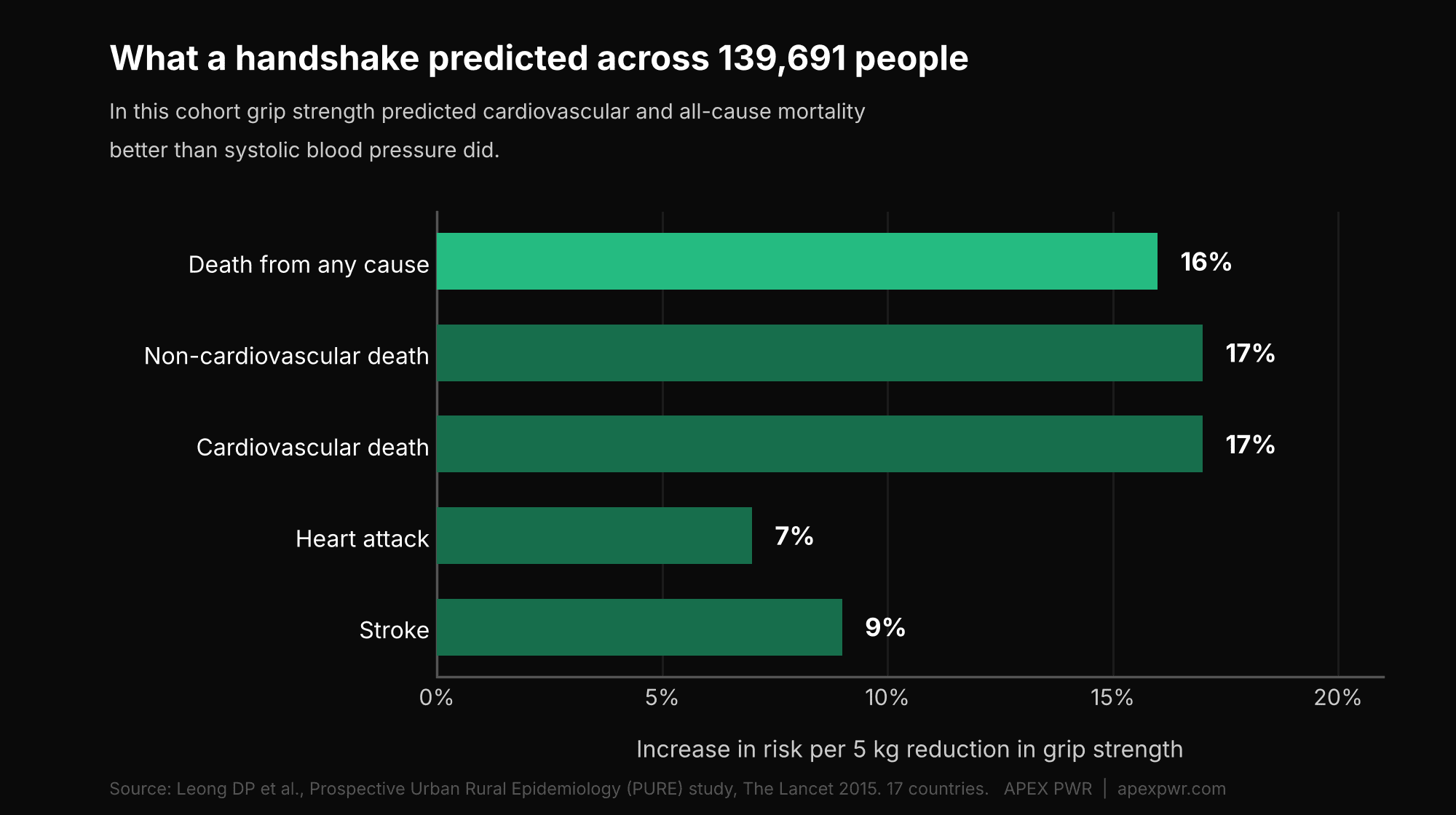
In a 139,691 person study across 17 countries, each 5 kg drop in grip strength was associated with about a 16 percent higher risk of death from any cause.
In that same cohort, grip strength predicted cardiovascular and all-cause mortality better than systolic blood pressure did.
Grip strength is a proxy, not a lever. Training your grip in isolation moves the number without moving what the number stands for.
Force plates separate out what a single strength number blends together: power, rate of force development, balance, and left-versus-right asymmetry.
Power declines earlier and faster than maximal strength does, and power is what you need when you catch a stumble.
A baseline in your forties or fifties is worth more than a first measurement in your seventies, because the useful information is the trajectory.
Our piece on bone density this week ends on a point worth repeating. A broken hip at seventy-four has two inputs: how strong the bone is, and how hard the ground hits it. Bone density scanning speaks to the first one. Nothing on a bone report speaks to the second.
This article is about the second one, and it starts with the single most interesting number in longevity research, which is also the cheapest to collect.
A Handshake Predicts More Than Your Blood Pressure
The Prospective Urban Rural Epidemiology study, known as PURE, measured grip strength with a handheld dynamometer in 139,691 adults across 17 countries, spanning high, middle and low income settings, and followed them for about four years.
16%
higher risk of death from any cause, per 5 kg reduction in grip strength
PURE, The Lancet 2015
17%
higher cardiovascular mortality risk, same 5 kg reduction
PURE, The Lancet 2015
139,691
adults measured across 17 countries, followed about four years
PURE, The Lancet 2015
Increase in risk per 5 kg reduction in grip strength, PURE study.
And the finding that got the attention: in this cohort, grip strength was a stronger predictor of cardiovascular and all-cause mortality than systolic blood pressure was.
Take a second with that. Blood pressure is checked at essentially every medical appointment any adult has ever attended. Grip strength is measured almost nowhere outside of research and a handful of facilities, and in a cohort of nearly 140,000 people it carried more predictive weight for mortality.
One of the most informative measurements in adult health takes about fifteen seconds and almost nobody has ever had it done.
Now the Part That Gets Misread
Every time this research circulates, a wave of grip trainers follows it. That misunderstands what the finding is.
Grip strength does none of the work itself. It stands in for something larger, which is the total amount of muscle you carry and your nervous system's ability to recruit it under demand. Both of those decline with age, with illness, with inactivity and with undernutrition, and both of them are genuinely hard to measure. A dynamometer gives you a reasonable estimate of the whole system for the price of a handshake.
Squeeze a spring in front of the television every night and your grip number will improve. The quantity it was standing in for will not have moved at all. Whole body resistance training is what moves the underlying thing, and grip comes along for the ride.
The Practical Reading
Grip strength is an excellent screen and a poor plan. It tells you whether to look closer. It does not tell you where the problem is.
What Force Plates See That a Single Number Cannot
A force plate measures the force your body applies to the ground, sampled thousands of times every second. Stand on one, do a few simple movements, and the software separates out physical qualities that a single strength test blends into one figure.
Power, not just strength
Strength is how much force you can produce. Power is how much force you can produce quickly. They are different qualities with different training requirements, and in aging they come apart. Power declines earlier and faster than maximal strength does. Someone can still move a respectable weight slowly and have lost a great deal of their ability to produce force fast.
Rate of force development
How quickly force climbs from zero. This is the quality that decides what happens in the quarter second after your foot catches an uneven paving slab. Maximal strength has almost no time to express itself in that window. Rate of force development is the whole story there.
Left versus right asymmetry
Most people load one side more than the other, often without noticing, frequently as a holdover from an old injury that resolved years ago. A total number hides this completely because the strong side compensates. Two plates see each leg separately.
Balance and postural control
Quiet standing looks like doing nothing. On a force plate it is a continuous stream of small corrections, and the character of those corrections changes measurably as balance declines. This is a quality you can train, and one almost nobody measures until after a fall.
Put those four together and you have a description of the second input to fracture risk. Not how strong the bone is. Whether you go down, and how hard, and whether you get a hand out in time.
Why a Baseline Now Beats a Measurement Later
Here is the thing about every number in this article. On its own, a single reading tells you where you sit against a reference population, which is mildly interesting. Two readings separated by a few years tell you your trajectory, which is the part that actually matters.
A woman who measures at the fiftieth percentile for power at fifty-two and the fiftieth percentile again at fifty-eight is in a completely different situation from one who was at the eightieth and has arrived at the fiftieth, even though their current numbers are identical. The second person is losing something quickly. Nothing about a single measurement would tell you that.
This is the same argument we make about bone, and about body composition scanning. Baselines are worth more the earlier you take them, and they are worth very little if you never take a second one.
The APEX Position
Grip strength tells you to look. Force plates tell you where. A plan built on either one alone is working from half the picture.
What This Looks Like Here
We built the Longevity Performance Analysis around exactly this gap. It is a one-to-one session with a Doctor of Physical Therapy or a Certified Strength and Conditioning Specialist, run on our force plates, covering strength, power, balance and asymmetry.
You leave with two things. A set of numbers you can compare against in five years, and a plan built on what those specific numbers say rather than on what a generic program assumes about someone your age.
The testing is the same equipment we use with the athletes who train here, which is how the technology reached us. The questions it answers for a fifty-year-old are different questions, and in our view more consequential ones.
Book a Longevity Performance Analysis
One-to-one on the force plates with a Doctor of Physical Therapy or a Certified Strength and Conditioning Specialist. Strength, power, balance and asymmetry, measured and explained in person. Tigard, Oregon, off Highway 217, minutes from Beaverton.
Tell us what you are trying to find out and we will tell you which assessment answers it, including when the honest answer is that you do not need one yet.
Frequently Asked Questions
Why is grip strength considered a longevity marker?
The PURE study followed 139,691 adults across 17 countries and found each 5 kilogram reduction in grip strength was associated with roughly 16 percent higher risk of death from any cause and about 17 percent higher cardiovascular mortality risk. In that cohort it predicted both better than systolic blood pressure. It works because it is a cheap readout of total body muscle and the nervous system's ability to recruit it.
Does squeezing a grip trainer make you live longer?
No, and this is the most common misreading. Grip strength is a proxy for systemic muscle and neural function rather than the cause of what it predicts. Isolated forearm work improves the number without improving the thing the number stands for. Whole body resistance training moves the underlying quantity.
What does force plate testing measure?
The force your body applies to the ground, thousands of times per second. From a few simple movements it produces lower body power, rate of force development, side-to-side asymmetry between your legs, and postural control during balance tasks. These are separate qualities that a single strength number blends together.
Is force plate testing only for athletes?
It started in sport, which is where the association comes from. The measures matter at least as much for adults who are not competing, because power, balance and asymmetry decide whether a stumble becomes a fall and whether a fall becomes a fracture. Those are longevity questions.
How does this relate to a DEXA scan?
They answer different halves of the same question. A bone density scan tells you how strong the bone is. Force plate testing speaks to how likely you are to fall on it and how hard. Fracture risk needs both.
This article is educational and is not medical advice, a diagnosis, or a substitute for care from your own physician. The research cited reports associations observed in population cohorts, which do not by themselves establish that changing one measure causes a change in the outcome. No assessment or training program can be promised to prevent a fall or a fracture. If you have a diagnosed condition affecting balance, bone or cardiovascular health, talk with your physician before beginning a new training program.
Sources. Leong DP, Teo KK, Rangarajan S, et al. Prognostic value of grip strength: findings from the Prospective Urban Rural Epidemiology (PURE) study. The Lancet, 2015; 139,691 participants across 17 countries; each 5 kg reduction in grip strength associated with approximately 16 percent higher all-cause mortality, 17 percent higher cardiovascular mortality, 17 percent higher non-cardiovascular mortality, 7 percent higher myocardial infarction risk and 9 percent higher stroke risk; grip strength a stronger predictor of cardiovascular and all-cause mortality than systolic blood pressure in this cohort. The observation that muscular power declines earlier and more steeply than maximal strength with advancing age is well established across the aging and neuromuscular literature and is stated here without a specific annual rate attached.
Fitness Is the First Thing Most Dads Drop. Two Ways Back. | APEX PWR Tigard & Beaverton APEX PWR | Dad Duty Fitness Is the First Thing Most Dads Drop By Jeron Mastrud, Co-Founder | Tigard, Oregon | October 14, 2026 APEX Co-Founder Jeron Mastrud working out at APEX Key Takeaways When work and fatherhood
RSMI: The Muscle Number on Your DEXA Report, and When It Should Send You to a Bone Scan | APEX PWR Tigard & Beaverton APEX PWR | Female Fitness RSMI: The Muscle Number on Your Report, and When It Should Send You to a Bone Scan By The APEX Team | Tigard & Beaverton, Oregon
Visceral Fat Climbs With Age. Get the Number Before It Does. | APEX PWR Portland & Tigard APEX PWR | Lessons in Longevity Visceral Fat Climbs With Age. Get the Number Before It Does. By The APEX Team | Tigard, Oregon | October 14, 2026 Key Takeaways Visceral fat sits around your organs. It is